India measures its progress in GDP figures and development indices. These numbers carry weight but they rarely ask a more fundamental question about who writes the policies that shape the lives standing behind those statistics. For Muslim women in India, long kept at the margins of the educational infrastructure that makes civil service entry possible in the first place, the answer is beginning to shift in ways that deserve serious attention. Entering the bureaucracy is not merely an act of personal ambition for these women. It is perhaps the most consequential path available to them to reshape the very structures that have defined and sustained their exclusion across generations.
To understand what this shift means, one must first understand where it is shifting from. The Census of India 2011 recorded Muslim female literacy at 51.89% against Muslim male literacy at 62.40%. That 12.7 percentage point intra-community gap is not simply a number. It is a measure of how differently the same household, the same poverty and the same social environment has historically treated its sons and daughters. More telling is that SC and ST communities, carrying their own deep histories of structural exclusion, have closed their intra-community gender literacy gaps at a faster rate over the same period. The barrier Muslim women face therefore runs deeper than poverty or state neglect alone. The Sachar Committee was clear that not religious conservatism but poverty is the primary driver of low educational participation among Muslim girls. Early marriage compounds this further, though NFHS-5 data reminds us that this is not a condition unique to Muslim households. The median marriage age for Muslim and Hindu women in India is comparable, situating early marriage as a shared structural problem rooted in economic precarity and patriarchal social norms rather than in any single community’s faith or culture. What is specific to Muslim women is the compounding of these pressures alongside inadequate educational infrastructure in Muslim concentrated localities and social norms that have historically narrowed the boundaries of what is considered appropriate ambition for a woman within the community.
Against this backdrop, something has been quietly changing. The All India Survey on Higher Education documents a consistent upward trend in Muslim women’s enrollment in higher education over the past two decades. This is not a sudden leap but a gradual accumulation, a generation of Muslim women entering colleges and universities in numbers that their mothers largely could not. The significance of this trend becomes clearest when one looks at where it has arrived.
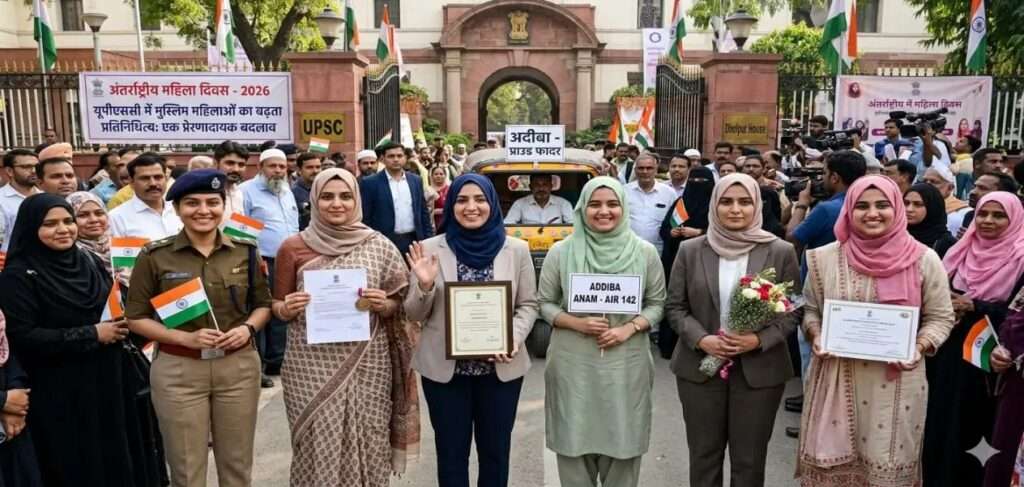
In UPSC Civil Services Examination 2025, 53 Muslim candidates cleared one of the most competitive examinations in the world. Thirteen of them were women, two placing within the top 30 nationally. The significance of this becomes sharper when placed against 2014, a year when the total number of selected candidates was comparable. That year only 4 Muslim women cleared the same examination. The same pool size, the same examination, yet three times the number of Muslim women clearing it a decade later. That is not a marginal shift. It is a structural one.
What the UPSC numbers represent goes beyond individual achievement. The examination is blind to religion, gender and background. It rewards preparation, persistence and intellectual rigor equally across every candidate. When Muslim women clear it in growing numbers, the data is making an argument that no amount of scepticism about what Muslim women can achieve can easily dismiss. The conditions the Sachar Committee documented in 2006 have not disappeared. But they are no longer the whole story. What this trajectory means for the institutions these women are now entering is a question the data alone cannot answer but one that it makes impossible to ignore.
Representation and the power to shape policy are not the same thing. India has long celebrated the presence of women and minorities in public life while the structures governing their communities have remained largely unchanged. Presence without institutional power is symbolic. What changes structures is not who is visible but who is in the room when decisions are made.
This is why the entry of Muslim women into the civil services carries a significance beyond the individuals who clear the examination. A bureaucrat shapes how policy is implemented at the ground level. She decides how welfare schemes reach minority concentrated localities, how educational infrastructure is prioritised and how the law is applied in communities where women’s rights have historically been mediated through male gatekeepers. When she comes from the community she is governing, the relationship between policy and lived experience is no longer entirely abstract.
Mary Beard, British classicist and feminist scholar, argues that the problem is not fitting women into existing structures but changing the structures themselves. The Muslim women entering the Indian bureaucracy today are not simply joining an institution. They are bringing into it a perspective shaped by the precise conditions that institution has historically failed to address. That is arguably the most consequential form of structural change available within a democratic framework.
The progress documented in the preceding sections does not emerge from a vacuum. It emerges despite conditions that the state itself helped create and sustain. The Sachar Committee was not merely a diagnostic exercise. It was an acknowledgment by the Government of India that Muslim communities, and Muslim women in particular, had been systematically underserved by the very institutions meant to serve all citizens equally. Inadequate schools in Muslim concentrated localities, low representation in public employment and the near absence of targeted educational support created conditions where the odds were structurally loaded against Muslim women before they even sat at a desk to study.
The state has not been entirely absent from this effort. Scholarship schemes, minority welfare programmes and targeted educational support have created some openings that did not exist before. The upward enrollment trend is in part a reflection of these interventions. But the gap between what these measures have achieved and what the Sachar Committee identified as necessary two decades ago remains wide. Progress that depends primarily on individual
determination to overcome structural disadvantage is progress that the state cannot take full credit for. What the data suggests is that state effort, community initiative and institutional support need to work in closer alignment than they currently do. When any one of these works in isolation the results are partial. When they reinforce each other the trajectory changes more decisively as the UPSC numbers of the past decade quietly demonstrate.
It would be intellectually dishonest to read the UPSC data as a signal that the structural conditions documented earlier have been resolved. They have not. The All India Survey on Higher Education records that Muslims account for only 4.9% of higher education enrollment against a 14% population share. The intra-community gender gap in literacy documented by the Census of India 2011 has narrowed but not closed. For every Muslim woman who reached the UPSC merit list in 2025, there are many more whose educational trajectories ended far earlier, not because of a lack of ability or ambition but because the structural conditions that make sustained education possible were simply not available to them.
The UPSC numbers are therefore best read as evidence of what becomes possible when conditions partially improve, not as evidence that the conditions have been sufficiently addressed. Celebrating a trajectory without honestly accounting for how many women that trajectory has not yet reached would be to mistake a beginning for an arrival.
The distance between the literacy figures the Census of India recorded in 2011 and the UPSC merit list of 2025 is not merely a decade of individual effort. It is a decade of slowly shifting conditions, imperfect and incomplete but directionally significant. The intra-community gender gap that places Muslim women behind Muslim men in educational attainment points to the work that remains within the community itself, where social norms rather than doctrine have historically defined the boundaries of women’s ambition. The enrollment trend that made the UPSC numbers possible suggests that sustained investment in educational infrastructure in Muslim concentrated localities is not charity but the precondition for the trajectory to continue. The presence of Muslim women in the bureaucracy suggests that representation must be understood not as an end in itself but as the means through which communities historically excluded from policy authorship begin to shape the conditions of their own lives. And the gap between what state interventions have achieved and what remains necessary suggests that the most productive path forward lies not in isolated effort but in the alignment of state responsibility, institutional openness and community support. The data does not tell a complete story. But it tells an honest one.