
“The runway where aircraft now take off was once the land where my family sowed crops.”
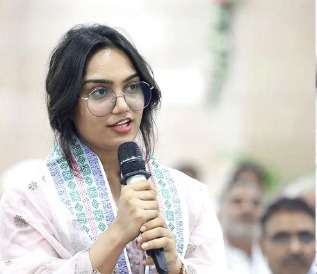
Few stories capture India’s changing landscape as profoundly as that of Dr. Hira Rashid. When she boarded one of the first commercial flights from the newly inaugurated Noida International Airport (Jewar Airport) in June 2026, it was more than a passenger’s first journey it was the culmination of a deeply personal story spanning generations.
The airport that now connects India to the world stands on land where her family once cultivated wheat and mustard. The fields that had sustained her ancestors for decades have transformed into one of India’s largest aviation hubs. For many, it was a news headline. For Dr. Hira Rashid, it was the meeting point of memory, sacrifice, and hope.
A Daughter of the Soil
Dr. Hira Rashid belongs to Rohi village in Uttar Pradesh’s Gautam Buddha Nagar district, a region that remained predominantly agricultural for generations. Like thousands of farming families in western Uttar Pradesh, her family depended on agriculture for their livelihood. The rhythm of life was dictated by the seasons sowing, harvesting, and caring for the land that had been passed down through generations.
For many girls growing up in rural India, aspirations are often shaped by circumstance. Access to quality education, particularly professional education, remains uneven. According to the National Family Health Survey (NFHS-5), while female literacy has improved significantly across India, rural women continue to face barriers related to higher education, mobility, and professional opportunities.
Against this backdrop, Hira’s dream was exceptional. She chose medicine.
Becoming a doctor demanded years of relentless study, discipline, and perseverance. It required crossing geographical, financial, and social barriers that many young women from rural backgrounds continue to encounter. Yet she remained steadfast, eventually earning her medical degree and dedicating herself to serving others.
Her journey reflected a broader truth: when a girl is educated, the impact extends far beyond one individual. It transforms families, communities, and future generations.
When Development Arrived at the Doorstep
In 2020, construction accelerated on what would become Noida International Airport, a flagship infrastructure project envisioned to ease pressure on Delhi’s aviation network and drive economic growth in northern India.
For families like Hira’s, however, development arrived with mixed emotions.
The land that had long defined their identity was acquired for the airport. Such transitions are rarely simple. Across India, infrastructure projects often involve difficult conversations about displacement, compensation, adaptation, and preserving community identity.
For farming families, land is more than property, it carries memories, livelihoods, and emotional attachment. Dr. Hira Rashid’s family experienced this transition firsthand.
Yet rather than allowing change to define them through loss alone, they chose to adapt.
The Flight That Became a Symbol
When commercial operations began, Dr. Hira Rashid became one of the first local residents to board a flight from the airport built on her family’s former farmland. As the aircraft lifted off the runway, it carried far more than passengers. It carried the story of a village.
A daughter who had grown up watching crops sway in those very fields was now flying above them as a doctor. The transformation was deeply symbolic—not because agriculture had ended, but because a family’s journey had evolved alongside India’s development.
It was a reminder that progress is ultimately about people. Infrastructure gains meaning only when it creates opportunities for those whose lives are intertwined with it.
Education as the Greatest Inheritance
What makes Dr. Hira Rashid’s story truly inspiring is that her greatest achievement is not taking the inaugural flight.It is becoming a doctor despite the limitations that many rural girls continue to face.
According to the All India Survey on Higher Education (AISHE), female enrolment in higher education has steadily increased over the past decade. Yet women from rural and minority communities remain underrepresented in professional fields such as medicine, engineering, and research.
Hira represents this quiet but significant transformation. She embodies a generation of Muslim women who are redefining expectations—not by abandoning their roots, but by expanding what is possible.
More Than a Personal Milestone
In many ways, Dr. Hira Rashid’s story mirrors contemporary India’s own journey. One generation cultivated fields. The next entered universities.
Today, their daughters are doctors, scientists, entrepreneurs, judges, military officers, and public leaders. This is not merely individual success; it is evidence of the transformative power of education.
Her story reminds us that development should never be measured only in kilometres of highways or the number of airport terminals built. Its true measure lies in whether it enables people especially women to realise their potential.
A Message for Every Young Girl
There will always be moments when change feels uncertain. Dreams may seem distant. Circumstances may appear overwhelming. But Dr. Hira Rashid’s journey teaches us that our beginnings do not determine our destination.
At Awaz-e-Khwateen, we celebrate women like Dr. Hira Rashid because their journeys redefine progress. They remind us that nation-building is not only about constructing airports it is about creating opportunities where daughters from every village can dream without limits.
Her story is ultimately not about the first flight from Jewar. It is about the first step every girl takes when she dares to believe that where she comes from will never limit where she can go.