Tooba Khatoon | updated by Yusra Siddiqui | Date- 03-08-2026 | Awaz-e-khwateen
“Justice is not measured by the number of laws enacted, but by the number of women who can confidently access them.”
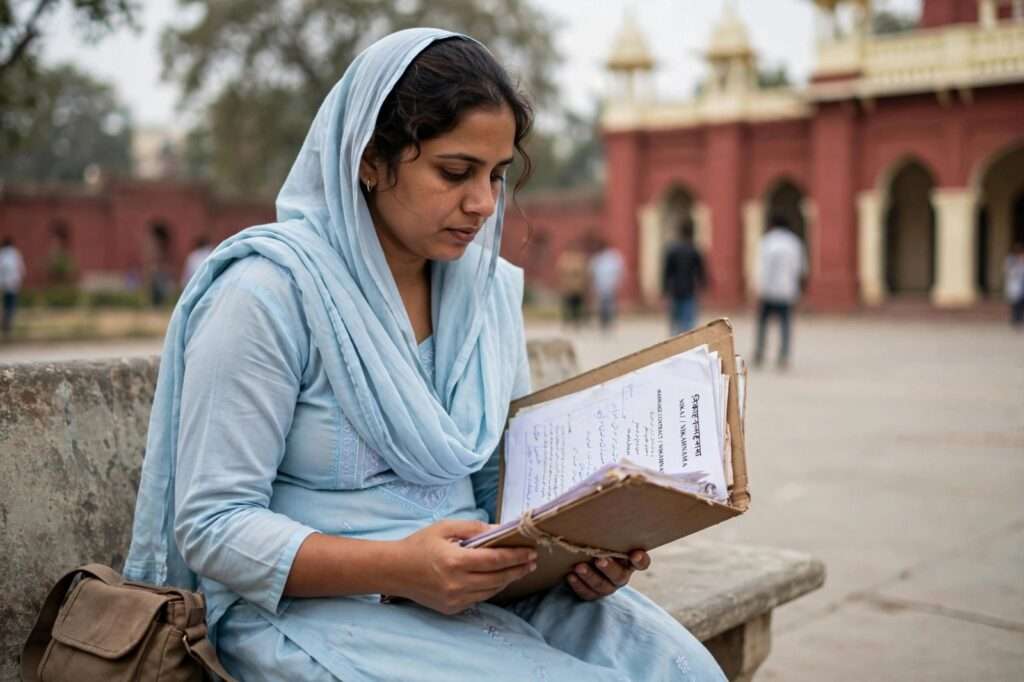
Late one evening, 32-year-old Sana (name changed) sat outside a family court in Lucknow holding a folder filled with legal documents her nikahnama, medical reports, bank statements, and copies of unanswered legal notices. Nearly two years had passed since her husband left for the Gulf promising to return within months. Instead, communication stopped, financial support ended, and every attempt to seek justice became another lesson in legal complexity.
Across India, thousands of women navigate disputes relating to marriage, maintenance, custody, inheritance, domestic violence, and abandonment. For Muslim women, these challenges often exist at the intersection of personal law, constitutional guarantees, social norms, and institutional barriers. While India has witnessed significant legal reforms over the past decade, the lived experience of many women suggests that access to justice remains uneven.
The recent submission of the National Commission for Women (NCW) report on the Rights of Muslim Women in India to the Ministries of Home Affairs, Women and Child Development, and Minority Affairs has once again brought these issues into national focus. The Commission has recommended strengthening legal awareness, improving access to justice, and introducing greater clarity through progressive codification of personal laws, particularly in matters relating to marriage, divorce, maintenance, custody, and inheritance.
The report presents an important opportunity not merely to debate laws, but to examine whether legal reforms have translated into meaningful empowerment for Muslim women.
Constitutional Rights and Personal Laws
India’s Constitution guarantees equality before law, prohibits discrimination on the basis of religion and sex, and promises every citizen the right to life and dignity. These constitutional principles form the foundation of women’s rights across communities.
However, matters relating to marriage, divorce, inheritance, and family relations continue to be governed through different personal laws.
For Muslim women, the legal framework has evolved through several significant legislations, including the Muslim Personal Law (Shariat) Application Act, 1937, the Dissolution of Muslim Marriages Act, 1939, the Muslim Women (Protection of Rights on Divorce) Act, 1986, and the Muslim Women (Protection of Rights on Marriage) Act, 2019, which declared instant triple talaq a punishable offence following the Supreme Court’s landmark decision in Shayara Bano v. Union of India.
These legal developments represent important milestones in recognising women’s rights within the constitutional framework. Yet legislation alone cannot transform lives unless women are aware of these rights and institutions respond effectively.
Rights on Paper, Justice in Practice
The NCW’s recent recommendations acknowledge an uncomfortable reality.India has strengthened its legal architecture, but implementation continues to lag behind. Legal literacy remains limited, particularly among women living in economically vulnerable and socially marginalised communities. Many women are unaware of maintenance rights, custody provisions, legal aid services, or institutional support systems available through district administrations and the National Commission for Women.
Even when women decide to pursue legal remedies, they often encounter lengthy court procedures, financial constraints, social stigma, and emotional pressure to preserve marriages at any cost. Justice delayed frequently becomes justice denied.Family disputes are rarely confined to legal questions alone. They involve financial dependence, children, community expectations, and psychological trauma.
Consequently, many women abandon legal proceedings long before justice is delivered.
Beyond Triple Talaq: The Questions That Still Need Answers
Public discourse has often reduced Muslim women’s rights to debates surrounding triple talaq. In reality, women themselves identify a much broader range of concerns. These include maintenance after separation, child custody, inheritance rights, domestic violence, property disputes, marital abandonment, legal documentation, and access to affordable legal assistance.
The NCW’s report reflects this broader understanding by recommending greater consistency and clarity in family law procedures while emphasising legal awareness and institutional accessibility.
This represents an important shift from viewing women’s rights purely as legal reform to understanding them as questions of implementation, awareness, and governance.
The Invisible Crisis of NRI Marriage Abandonment
Perhaps one of the most overlooked dimensions of women’s rights is the growing problem of NRI marital abandonment.
Recently, NCW Chairperson Vijaya Rahatkar highlighted that nearly 32,000 women in Punjab have reportedly been abandoned by NRI husbands over the years, describing it as a growing challenge requiring stronger coordination between police, administration, and legal institutions.
Although these cases affect women across religious communities, they reveal a larger institutional challenge. Marriage today frequently extends beyond national borders, but legal remedies often remain confined within them.
Women abandoned by spouses living overseas face enormous practical difficulties serving legal notices, securing maintenance, enforcing court orders, tracing assets, and obtaining custody arrangements. The emotional consequences are equally severe. Years pass in uncertainty while women struggle to rebuild their lives, often without financial support or institutional guidance.
These cases demonstrate that legal protection cannot stop at legislation. It must include effective implementation mechanisms, international cooperation, and survivor-centred legal assistance.
Legal Awareness Is the Missing Link
One of the strongest observations emerging from both government initiatives and civil society organisations is that legal awareness remains remarkably low. Many women first approach lawyers only after relationships have completely broken down.
Preventive legal literacy receives far less attention than crisis intervention. Community-based legal awareness programmes, university legal aid clinics, women’s collectives, and digital information platforms have the potential to bridge this gap.
Justice begins long before a courtroom. It begins when a woman knows that she has rights.
Toward Meaningful Reform
The debate surrounding Muslim women’s rights should no longer be framed as a contest between tradition and modernity. Instead, it should focus on a more fundamental constitutional question:
Can every woman, irrespective of religion or social background, access justice with dignity, affordability, and confidence?
The answer depends not only on Parliament or the judiciary, but also on institutions, communities, educators, legal professionals, and civil society. Legal reform has opened important doors.
The challenge now is ensuring that every woman can walk through them. The NCW’s recommendations therefore deserve to be viewed not as the end of a conversation but as the beginning of a more comprehensive approach one that combines legal reform with legal literacy, institutional accountability, economic empowerment, and accessible support systems.
Only then will constitutional promises move beyond legislation and become part of women’s everyday lives.