Story by Tooba Khatoon | New Delhi |
History often remembers freedom fighters through their speeches, arrests and public positions. But there were also women whose contribution was woven into the everyday fabric of the freedom struggle women who raised children to resist injustice, opened their homes to political activity and turned their personal lives into acts of patriotism.
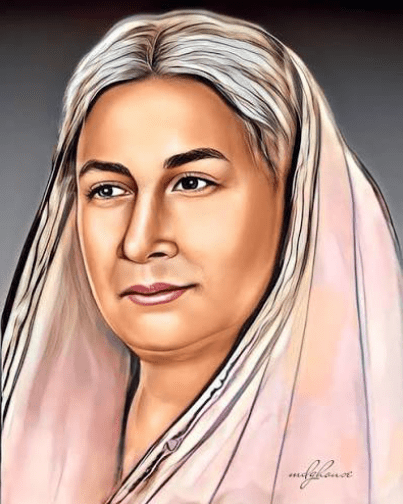
Syed Fakrul Hajiya Hassan of Hyderabad was one such woman.
Little is widely known today about her, and that itself tells us something about how women’s participation in the freedom struggle has been remembered. She was not simply a woman who supported the movement from the sidelines. She participated in the nationalist struggle herself and, perhaps even more significantly,
raised her children to become part of it
.
Syed Fakrul Hajiya Hassan came from a family with roots in Iraq, which had migrated to India. She eventually made Hyderabad her home after marrying Amir Hassan, a senior official in the Hyderabad administration who had originally come from Uttar Pradesh. Through marriage, she became deeply connected with Hyderabad’s social and cultural life. But her world was not limited to her household.
Her husband’s work required him to travel to different places, and during these journeys Hajiya Hassan saw something that stayed with her the difficult circumstances in which many Indian women lived. She became particularly concerned about women’s education and the opportunities available to girls. Her understanding of freedom therefore went beyond the question of British rule. For her, a society could not truly progress while its women remained denied education, dignity and opportunity.
That belief became an important part of the way she raised her own children.
Hajiya Hassan encouraged her children to participate in the national movement. Her sons eventually became known as the “Hyderabad Hassan Brothers”, carrying forward the political consciousness that their mother had cultivated at home. In this sense, her contribution was both public and deeply personal. She did not simply tell her children to be successful; she taught them that their education, courage and abilities should serve a larger cause.
Her own political participation became more visible during the Non-Cooperation and Khilafat movements. Hyderabad presented a particularly complex political environment because it was a princely state ruled by the Nizam while remaining under British paramountcy. Yet the national movement reached into the city, and Hajiya Hassan became one of the Muslim women who responded to the call for swadeshi and resistance.
One of the most striking episodes associated with her took place at her home, Abid Manzil in Troop Bazaar, Hyderabad.
Responding to Mahatma Gandhi’s call to boycott foreign goods, Hajiya Hassan burned foreign clothes at her residence. Today, burning imported cloth may sound like a small symbolic act. But during the freedom movement, rejecting foreign goods was a deliberate political statement. Swadeshi transformed ordinary objects clothes, spinning wheels, household goods—into symbols of resistance. By publicly rejecting foreign cloth, Hajiya Hassan was declaring that the struggle for freedom had entered her own home.
And her home itself became significant.
Abid Manzil was not merely a private residence. It became part of the social and political environment in which nationalist ideas were discussed and encouraged. For women who could not always enter political spaces freely, such homes could become important places of participation. The freedom movement was sustained not only in public meetings and political offices but also through these less visible networks.
Hajiya Hassan’s nationalism was also reflected in the way she thought about the people fighting for India’s freedom. She reportedly regarded every soldier of the Indian National Army as one of her own children. That sentiment became particularly important after the Second World War, when the fate of INA soldiers became a major national issue.
The Indian National Army, associated with Subhas Chandra Bose and the Azad Hind movement, had challenged British rule militarily. After the war, many INA officers and soldiers were arrested and put on trial. The trials generated enormous public sympathy across India and became an important moment in the final phase of the independence movement.
Hajiya Hassan joined efforts demanding the release of the Azad Hind Fauj personnel. She worked alongside prominent women such as Sarojini Naidu, adding her voice to the campaign for the freedom fighters who had been imprisoned by the British. There is something deeply moving about the way she is remembered in this context. She did not see the INA soldiers simply as distant political figures
She saw them as her children.
That idea captures something important about the emotional side of India’s freedom movement. Nationalism was not always an abstract political philosophy. For many people, it became a deeply personal relationship with those who were sacrificing their lives, families and futures for the country.
Hajiya Hassan’s life also reminds us that Muslim women participated in the freedom struggle in many different ways. Some addressed political gatherings. Some organised women. Some raised funds. Some joined protests. Others worked through education, literature and
social reform. And women like Hajiya Hassan used the spaces available to them—the home, family, community and social networks to nurture resistance. Her story is particularly important because she was not only a participant; she was also a political mother.
The phrase may sound simple, but it carries enormous significance. Mothers have often been placed outside conventional political history. Their work is described as “support” rather than political participation. Yet raising children with a commitment to freedom, encouraging them to join a dangerous movement and standing behind them when the consequences became serious were themselves acts of political courage.
Hajiya Hassan’s story asks us to reconsider what we mean when we say that someone “participated” in the freedom struggle. Was participation only marching in the streets? Was it only going to prison? Or could it also mean refusing foreign cloth, supporting swadeshi, encouraging children to join the national movement, working for women’s education and standing beside political prisoners?
If the answer is the latter, then Hajiya Hassan belongs firmly within India’s freedom story.
She died in 1970, more than two decades after India became independent. She therefore lived long enough to see the country for which she had struggled become free. But independence did not erase the importance of remembering what women like her had contributed to achieving it.
Today, her name does not have the visibility of many better-known national figures. There are no large monuments associated with her, and her story rarely appears in mainstream accounts of the freedom movement. Yet her life represents a much larger group of women whose work remained close to the ground women who converted their homes into spaces of resistance and their families into participants in the national movement. For an Independence Day series on Muslim women in India’s freedom struggle, Hajiya Hassan’s story is therefore especially meaningful. Because sometimes history is not made by the person standing at the microphone.Sometimes it begins with a mother telling her children:
“This country is worth standing up for.”
And sometimes, years later, those children carry that lesson into the streets, into political movements and into history. Syed Fakrul Hajiya Hassan was one of those mothers.
Her contribution deserves to be remembered not merely as the story of the woman behind the “Hyderabad Hassan Brothers”, but as the story of a woman who chose freedom, believed in women’s progress and turned her own household into a part of India’s struggle for independence.
Her story. Our heritage.
This Independence Day, let us remember the Muslim women whose names may have faded from textbooks but whose courage did not fade from the history they helped create.