Tooba khatoon | New Delhi | 15 AUGUST 2026
Every year, as August 15 approaches, we return to the familiar images of India’s freedom struggle—the tricolour, Gandhi’s walking stick, the speeches of Nehru, the sacrifices of revolutionaries, and the stories of leaders whose names have become part of our collective memory. But the history of India’s Independence is much larger than the names we usually remember. It was also shaped by women who worked quietly, often outside the formal political structures, and whose contributions rarely received the same attention. Among them were Muslim women who participated in different ways—as political workers, educators, social reformers, organisers, peace activists and mothers who encouraged the next generation to participate in the national movement.
To speak about their contribution is not simply to add a few forgotten names to the history of Independence. It is to understand the freedom struggle differently. The movement was not fought only in prisons, political meetings or on the streets. It also happened inside homes, classrooms, women’s gatherings, neighbourhoods and refugee camps. For many women, especially those who came from conservative social environments, entering public life itself was an act of courage. Their stories show that the struggle for India’s freedom was also connected with questions of education, women’s dignity, communal harmony and social reform.
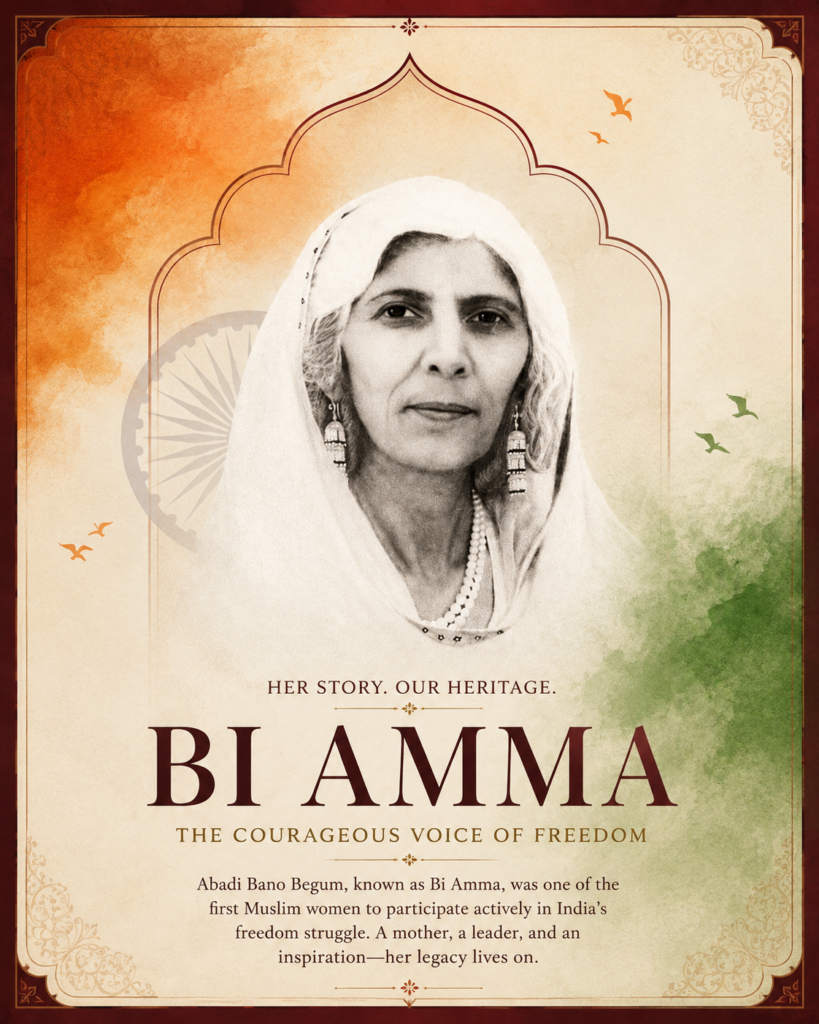
One of the women who represents this less visible side of the movement is Abadi Bano Begum, popularly remembered as Bi Amma. Born in Amroha in the mid-nineteenth century, she was widowed at a young age and had to raise her children in difficult circumstances. She had received little formal education herself, but she understood the importance of education so deeply that, when resources were limited, she reportedly pawned her jewellery to ensure that her children could study. Two of her sons, Maulana Mohammad Ali Jauhar and Maulana Shaukat Ali, later became prominent figures of the Khilafat and nationalist movements. But remembering Bi Amma only as the mother of the Ali Brothers would be to overlook her own political contribution. She entered public political life, addressed gatherings, mobilised women, raised funds and encouraged participation in the nationalist movement. Her journey from a young widow struggling to educate her children to a woman participating in India’s political struggle tells us something important: sometimes political
resistance begins with a very personal decision about what kind of future one wants for one’s children.
Then there was Bibi Amtus Salam, whose life became closely associated with Gandhi and the difficult work of communal harmony. Born into a conservative Muslim family in Patiala, she had herself experienced restrictions on women’s education and mobility. She eventually rejected purdah and entered a life of public service. She became a close associate of Mahatma Gandhi, who regarded her as a daughter. But what makes her story particularly important is the period around Partition. When communal violence tore through parts of India in 1946 and 1947, Amtus Salam did not remain a distant observer. She worked in riot-affected areas and became involved in efforts to rebuild trust between communities. In Noakhali, she undertook a prolonged fast as part of efforts to restore communal peace. After Partition, she worked for the evacuation and rehabilitation of displaced women and travelled to Pakistan in connection with refugee relief.Her life reminds us of a difficult truth: Independence and Partition arrived almost together,
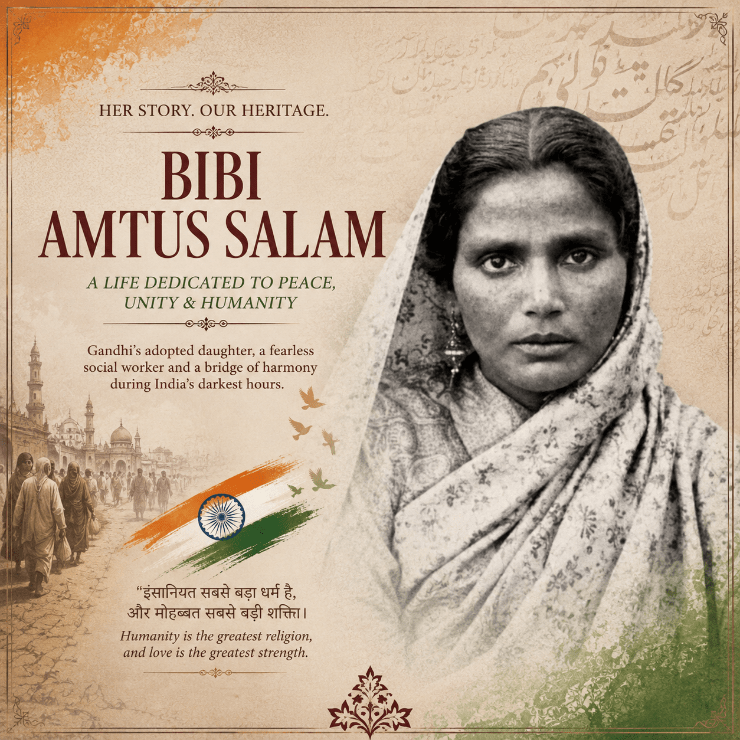
and for many people the freedom of 1947 was accompanied by displacement, violence and loss. Women like Amtus Salam spent the years around Independence not simply celebrating a new nation but trying to heal the wounds through which that nation was born.
Kulsum Sayani represents another form of resistance—resistance against illiteracy. Born in 1900, she came into contact with Mahatma Gandhi as a young woman and gradually became involved in social reform and the national movement. Her work was particularly focused on adult education and literacy. She understood that political freedom could not mean very much to people who remained unable to read, access information or participate confidently in public life. Her work among adults, particularly women, therefore became a form of nation-building. Research on her work records her efforts to develop education programmes for Muslim women in Bombay, beginning with very limited resources. She also became associated with Rahbar, a publication designed for new adult readers and published in Hindi, Urdu and Gujarati. Her approach was practical: if newly literate people were learning to read, they also needed material that spoke to them in language they could understand. Years later, Jawaharlal Nehru personally supported her work, recognising her contribution to adult education and social service. Kulsum Sayani’s life makes us reconsider what we call a freedom struggle. Teaching someone to read may not look as dramatic as standing in a protest, but for a person who had been denied education, literacy could be the beginning of independence in its most personal form.
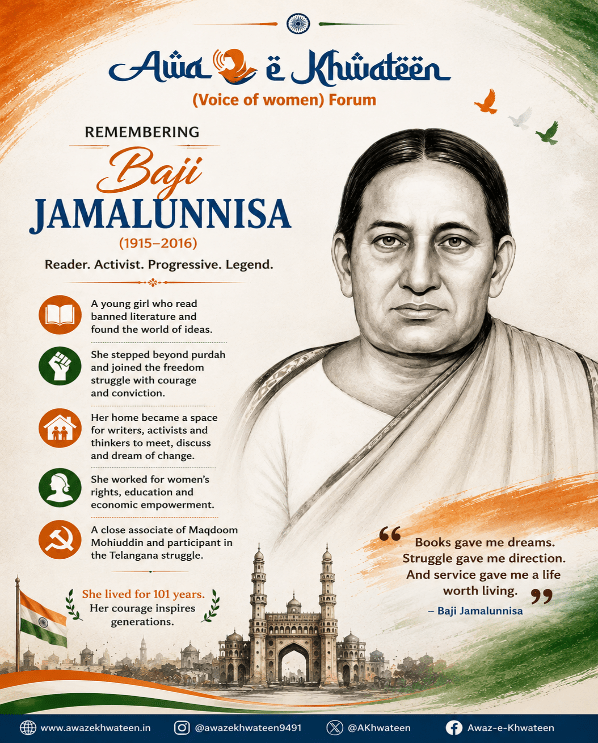
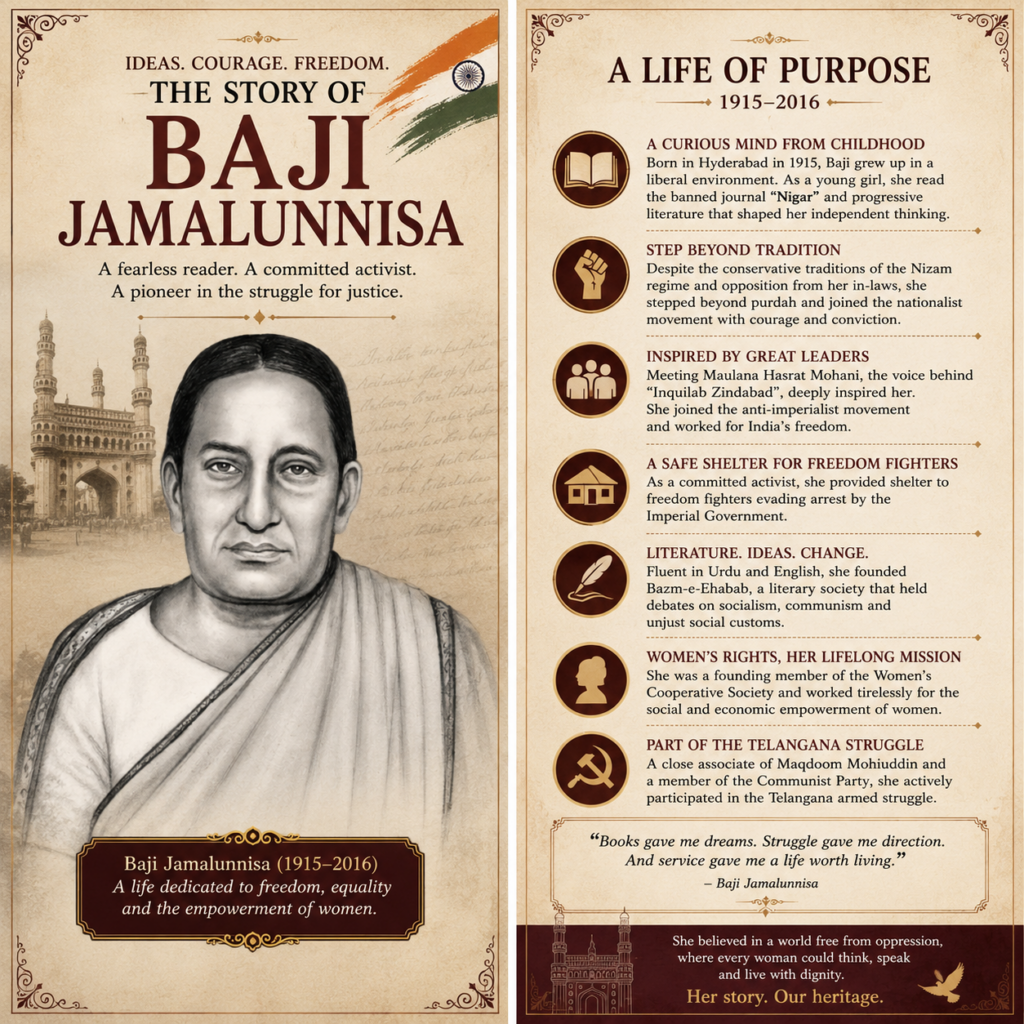
In Hyderabad, Baji Jamalunnisa followed yet another path. Born in 1915, she grew up in an environment where she encountered progressive literature from an early age. She became associated with progressive political and literary circles and later participated in the Telangana struggle. Her life was documented through oral-history work undertaken by Stree Shakti Sanghatana in Hyderabad, making her story particularly valuable because it comes through the memories and experiences of women who lived through the Telangana People’s Struggle. Jamalunnisa was not simply interested in politics as something that happened in distant institutions. She helped create spaces where people could discuss literature, socialism, communism and social customs. Her life demonstrates how reading itself could become a political act for women, especially in societies where women were expected to accept rather than question. Her story also reminds us that the history of Muslim women in the freedom movement cannot be reduced to one political ideology. They participated in different movements and traditions, sometimes nationalist, sometimes Gandhian, sometimes progressive or left-oriented, but they shared a willingness to challenge the boundaries placed around their lives.
These women were not identical, and it is important not to make them appear as though they all followed the same political path. Bi Amma was deeply connected with the Khilafat and nationalist movements; Amtus Salam worked through Gandhian principles of non-violence and communal harmony; Kulsum Sayani concentrated on adult education and social reform; and Baji Jamalunnisa became part of progressive and Telangana political circles. Their political contexts were different, their methods were different and their personal journeys were different. What connects them is not a single ideology but the fact that they refused to accept that the making of India’s future was exclusively a man’s responsibility.
This is also where the question of memory becomes important. Women’s participation in history is often remembered differently from men’s. A man’s political activity may be recorded as leadership, organisation or resistance, while a woman’s similar work is sometimes described simply as “support.” A woman who raised children who became freedom fighters is remembered as a mother. A woman who organised literacy classes is remembered as a social worker. A woman who worked in riot-affected areas is remembered for her compassion. But these descriptions can unintentionally make their political contribution disappear.
Take Bi Amma, for example. Saying that she was the mother of the Ali Brothers is factually correct, but it is not enough. She was also a woman who entered political spaces at a time when public political participation by Muslim women was far from ordinary. Similarly, calling Amtus Salam Gandhi’s “adopted daughter” tells us about her relationship with Gandhi, but it does not fully explain the difficult work she undertook during communal violence and refugee rehabilitation. Calling Kulsum Sayani an educationist does not capture the political significance of making literacy accessible to adults who had been excluded from education. And remembering Baji Jamalunnisa only through her political affiliations misses the courage involved in creating intellectual spaces for women in Hyderabad.
Perhaps this is why their stories matter so much today. Independence Day is often presented as the end of a struggle, but for these women, freedom was never simply about the departure of the British. It was also about what kind of society Indians would build afterwards. Would women have access to education? Would communities be able to live together despite differences? Would ordinary people be able to participate in public life? Would those displaced by Partition find a place to rebuild their lives? Would women be allowed to speak, organise and think for themselves?
Their lives suggest that the answer to these questions was never automatic. Political independence was only one part of the larger journey.
There is also something deeply human in the way these women entered the national movement. They were not born as historical figures. They were daughters, wives, mothers, teachers, readers and social workers before history gave them a place in its pages. Bi Amma was a mother trying to educate her children. Amtus Salam was a woman who chose to leave the restrictions of her early life. Kulsum Sayani was an educator who believed that a person learning to read could change the course of a family. Baji Jamalunnisa was a woman who found political possibility in books, conversations and collective action. Their decisions accumulated over years until they became part of something much larger than themselves. That is perhaps the history we need to remember this Independence Day.
India was not built only by the people whose photographs now hang in government buildings. It was also built by people whose names survived in old newspapers, oral histories, letters, memoirs, archives and family memories. It was built by women whose political work often happened in spaces that historians once considered private rather than political. It was built by people who raised funds, taught others, opened their homes, organised meetings, sheltered activists, worked with refugees and tried to keep communities together when the country was breaking apart.
Remembering Muslim women in India’s freedom struggle is therefore not about presenting them as a separate footnote to the national story. They are already part of that story. Their religion, gender and social circumstances shaped the way they experienced the freedom struggle, but their aspirations were also deeply connected with the larger question of what India could become.
This Independence Day, perhaps we should look beyond the familiar photographs and ask ourselves whose voices are missing from the picture. Who worked without expecting their names to become famous? Who entered public life despite social restrictions? Who educated others when education itself was a privilege? Who chose peace when violence seemed easier? Who encouraged their children to serve a country that did not yet exist as a free nation?
The answer includes women like Abadi Bano Begum, Bibi Amtus Salam, Kulsum Sayani and Baji Jamalunnisa.
They were not merely witnesses to India’s freedom struggle.
They were participants in it.
And remembering them today is not about looking backwards with nostalgia. It is about understanding that the India we celebrate on August 15 was shaped by countless people whose names did not always make it into our textbooks.
Their stories are not outside India’s history. They are part of the history of India. This Independence Day, let us remember the women whose names history almost left behind.
Her Story. Our Heritage.
Awaz-e-Khwateen