Mohd Zafar | Residential coaching Academy | Updated by Tooba Khatoon |
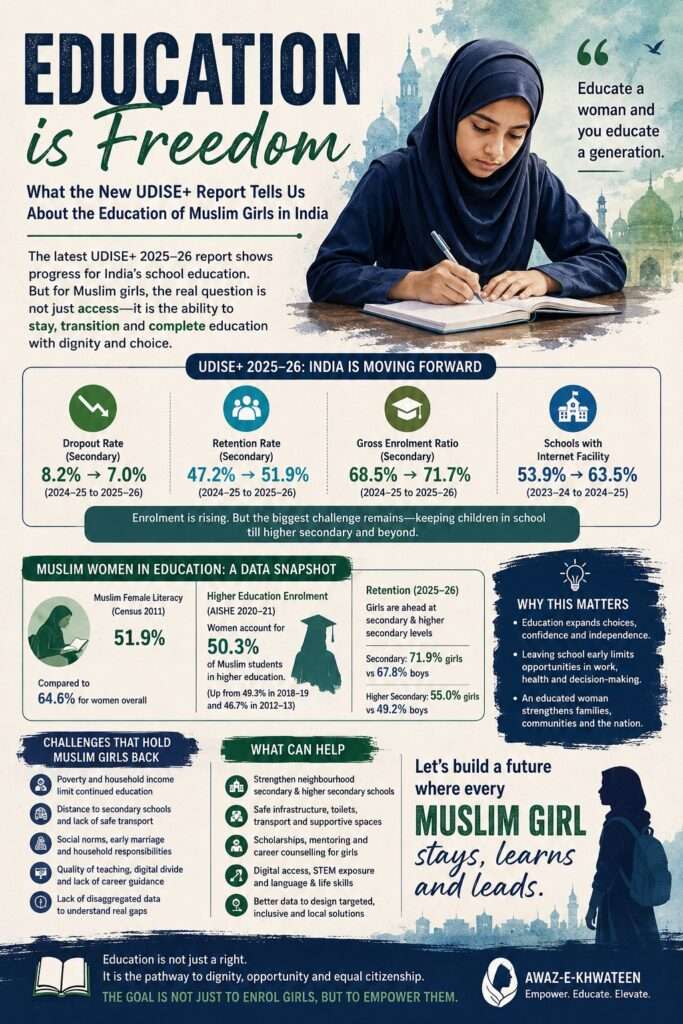
The latest Unified District Information System for Education Plus (UDISE+) 2025–26 report, released by the Ministry of Education in July 2026, presents a picture of an Indian school system that is making measurable progress but is still struggling with the most difficult part of the educational journey: keeping children in school as they move towards secondary and higher secondary education. The national secondary-school dropout rate has fallen from 8.2 per cent in 2024–25 to 7.0 per cent in 2025–26, while secondary-level retention has improved from 47.2 per cent to 51.9 per cent. The Gross Enrolment Ratio at the secondary level has also risen from 68.5 per cent to 71.7 per cent.
These are encouraging numbers. But national averages can sometimes hide the questions that matter most. For Muslim girls, the question is not simply whether more children are entering school. It is whether girls are able to stay, transition, complete secondary education, enter higher education and eventually convert education into meaningful opportunities.
This distinction is important because the educational story of Muslim women in India cannot be reduced to a single statistic. The last comprehensive Census data, from 2011, recorded Muslim female literacy at 51.9 per cent, compared with 64.6 per cent for women overall. At the same time, research based on Census
and other secondary data has documented considerable differences between states and between rural and urban areas. In other words, there is no single “Muslim woman’s educational experience” in India. Geography, household income, availability of schools, social environment and the broader educational performance of a state all matter.
The new UDISE+ numbers are particularly significant because they shift attention from access to continuity. India has made substantial progress in bringing children into the school system, but the transition to higher classes remains a serious challenge. The latest report puts retention at 83.7 per cent at the middle stage but only 51.9 per cent at the secondary stage. In simple terms, getting a child into school is increasingly not the only problem; ensuring that the child remains there until the end of school is becoming equally important.
For Muslim girls, this matters enormously. Leaving school at the secondary stage can have consequences that extend far beyond education. It can reduce access to formal employment, professional courses, higher education and digital opportunities. It can also narrow the age at which a young woman begins to make independent decisions about work, mobility and her future. Education is therefore not simply a classroom experience; it is one of the mechanisms through which a young woman acquires information, confidence, social networks and the ability to imagine choices beyond the immediate circumstances of her household.
There is also an important development in the data that deserves attention: girls are not necessarily the group falling behind at every stage anymore. Analysis of UDISE+ 2025–26 indicates that girls have higher retention than boys at both secondary and higher-secondary levels nationally. Secondary retention is reported at 71.9 per cent for girls compared with 67.8 per cent for boys, while higher-secondary retention is 55.0 per cent for girls compared with 49.2 per cent for boys.
This is an important corrective to the way girls’ education is sometimes discussed. The question should no longer simply be, “Why are girls dropping out?” It should also be, “Which girls are still being left behind, and why?”
That distinction becomes particularly relevant when we talk about Muslim girls. National gender averages cannot tell us whether improvements are being experienced equally across religious, socio-economic and geographical groups. UDISE+ provides extensive information on school education, but it does not, by itself, provide a complete picture of the educational journey of Muslim women from school to employment. That gap in disaggregated evidence is itself important. We need better intersectional data that allows gender to be examined alongside religion, location, socio-economic background and disability without turning any community into a stereotype.
There is, however, reason to look beyond narratives of educational deprivation. The story of Muslim women in higher education has changed considerably. Analysis of AISHE 2020–21 data showed that women accounted for approximately 50.3 per cent of Muslim students enrolled in higher education, up from 49.3 per cent in 2018–19 and 46.7 per cent in 2012–13. In other words, among those Muslim students who do reach higher education, women have increasingly represented half or slightly more than half of enrolment.
This creates an interesting contradiction. On one side, historical data shows substantial educational disadvantage among Muslim women, particularly in literacy and higher educational attainment. On the other, the women who are reaching higher education are increasingly participating in numbers comparable to, and in some contexts exceeding, men. The real challenge therefore lies not simply in encouraging Muslim girls to study, but in ensuring that the educational pipeline does not lose them along the way.
The latest UDISE+ report also reminds us that infrastructure matters. Between 2023–24 and 2024–25, the proportion of schools reporting computer facilities increased from 57.2 per cent to 64.7 per cent, while those reporting internet facilities rose from 53.9 per cent to 63.5 per cent. For girls from communities and households with limited access to technology at home, the school may be the most reliable place where digital learning becomes possible.
But infrastructure on paper is not the same thing as meaningful access. A school may have an internet connection without every student having the opportunity to use it. A computer may exist without adequate digital instruction. A girl may have a smartphone without having the freedom, skills or confidence to use it for education. The next phase of educational policy therefore needs to move from availability to usability.
This is particularly important because education itself is changing. A young woman entering higher education today is not preparing simply for a conventional degree. She is entering a world of digital employment, online entrepreneurship, professional certification, remote work and rapidly changing skill requirements. If Muslim girls are to participate equally in this economy, educational inclusion must include digital literacy, English and language skills, financial literacy, career counselling, STEM exposure and access to information about scholarships and higher education.
The issue of distance also deserves greater attention. Earlier studies of Muslim women’s education have repeatedly highlighted regional differences and the relationship between the educational environment of a state and the educational outcomes of Muslim women. Evidence has shown that Muslim female literacy tends to be substantially higher in states with stronger overall female educational outcomes, while poorer educational environments often affect Muslim women disproportionately. This suggests that improving Muslim women’s education cannot be separated from strengthening public education systems more broadly.
At the same time, it would be misleading to explain educational gaps entirely through community attitudes. Poverty, inadequate school infrastructure, distance from secondary schools, household responsibilities, quality of teaching, safety concerns and the cost of continuing education can all influence whether a girl remains in school. Research on Muslim girls’ access to higher education has similarly identified socio-economic conditions alongside family attitudes and institutional factors.
This is where the conversation needs to become more nuanced. Muslim women do not need to be portrayed either as victims waiting to be educated or as a community that has already overcome every barrier. Both narratives are incomplete. There are millions of Muslim girls studying in schools, colleges and universities, entering professional courses, becoming researchers, teachers, doctors, entrepreneurs and public professionals. At the same time, there remain girls whose educational journeys end much earlier than their aspirations.
The latest UDISE+ report therefore should not be read simply as a story of falling dropout rates. It should be read as an invitation to ask more precise questions. Who is completing secondary school? Who is transitioning to higher secondary education? Who is reaching college? Who is studying science, technology, law or professional courses? Who has access to digital learning? And, perhaps most importantly, who disappears from the educational system before anyone notices?
For Muslim women, education has consequences that extend into almost every sphere of life. It influences employment, health awareness, financial independence, political participation, entrepreneurship and the educational aspirations of the next generation. An educated woman does not simply acquire a certificate; she gains greater access to information and institutions and, often, greater capacity to negotiate the decisions that shape her life.
India’s education story is therefore moving into a new phase. The challenge is no longer only to build schools and increase enrolment. It is to ensure that every girl who enters the classroom has a realistic pathway to stay there, complete her education and decide what she wants to do with it.
For Muslim girls, that means replacing broad assumptions with better data, replacing one-size-fits-all interventions with locally responsive policies, and understanding education not merely as a welfare measure but as a question of agency, opportunity and equal citizenship. The latest UDISE+ numbers show that India is moving forward. The more important question is whether every girl is moving forward with it.