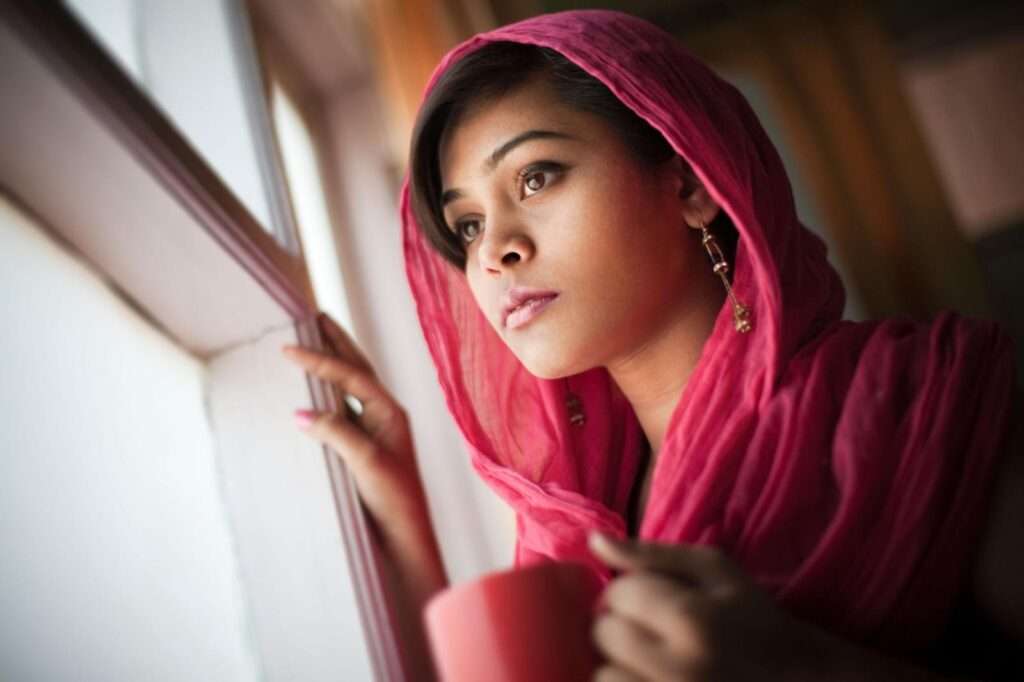
From “log kya kahenge?” to the pressure to always adjust, girls are often taught that goodness means obedience. But respecting family and tradition should never require a woman to surrender her voice, choices or freedom.
Ifat Amin
From a young age, many girls in India learn that a good woman is one who stays quiet, sacrifices her own needs and never causes a stir. They’re taught to lower their voice, swallow discomfort and apologise, even when they’ve done nothing wrong.
In practice, respect and tradition have come to mean that women must always defer to others. As one feminist scholar notes, modern patriarchy “prioritize[s] the male point of view” and treats women as inherently lesser, while feminism itself “aim[s] to define and establish the political, economic, personal, and social equality of the sexes”.
In other words, believing women deserve equal rights and opportunities clashes with treating them as role models of obedience.
“What Will People Say?” The Fear of Collective Judgement
A telling phrase that we have grown up hearing, “Log kya kahenge?” (“What will people say?”). This question hangs over a girl’s choices, her decision to study late into the night, reject an arranged marriage, take on a new job, or simply speak up in disagreement suddenly feels like a breach of family honour.
In this climate of social scrutiny, a young woman’s aspirations become a matter of community gossip. She learns to anticipate disappointment, carefully edit her words and feel guilty for dreams others might pursue without comment.
Thus good intentions (“concern” or “advice” from elders) effectively train girls to censor themselves. A “good girl” is never the one who challenges expectations.
Of course, people who enforce these rules often believe they’re acting in love. Parents and elders may repeat the traditions they grew up with, thinking they protect their daughters from harm or social stigma.
But well-meaning intent does not make unfair rules right. Tradition deserves respect only when it upholds true values, not when it demands one group continually sacrifice their freedom. If a custom requires daughters to give up all comfort and choice for the sake of family “peace,” we must ask whether we are preserving something meaningful, or simply preserving an unequal power balance.
When “Respect” Means Restriction
On paper, “respect” sounds laudable. In practice, however, it has become a one-way demand on women: they must always defer, while others call the shots.
A daughter is reminded not to answer back, not to demand anything that might upset anyone else. A boy who speaks his mind is “confident,” but a girl is “arrogant.” A man who says “no” exercises his rights, but a woman who does is told she’s rude or ill-bred. Over time, obedience becomes ingrained as a personality trait , even when it’s actually a habit formed under social pressure.
Therapist Vidhi Naik vividly describes this invisible pattern: her own mother, a working professional, would wake first to feed everyone else and sleep last , even through back pain , because “things had to be done.”
Naik recalls feeling frustrated: “Why can’t she just rest? Why does her health always last?”. This image of women (even educated, strong women) quietly sacrificing themselves rings true for many. The endless household chores , cooking different meals for each family member, managing every small detail, absorbing stress and burdens without complaint , often goes unnoticed. Not out of cruelty, but because it is simply expected that a “good woman” will shoulder it all.
We cannot ignore the real costs. Many mothers and grandmothers have internalised the idea that their worth comes from giving , and guilt their daughters if they do otherwise.
Women learn that saying “no” or setting boundaries somehow makes them “bad” daughters or disrespectful. Yet a woman’s independence is not evidence of poor upbringing; her goodness cannot be measured by how quietly she lives. In fact, treating women as mere carriers of the family’s image breeds resentment and stifles potential.
The Numbers Speak
These aren’t abstract problems: statistics show how deeply ingrained the bias is. Government surveys and studies paint a grim picture. For example, India’s gender ratio is dramatically skewed by son-preference: a 2018 report found “more than 63 million women are ‘missing’ in India, and more than 21 million girls are unwanted by their families”.
Girls routinely receive less nutrition, poorer healthcare and lower education than boys , choices families would never make for sons. (Even wealthy or educated parents, the survey noted, often keep trying for a son, and some celebrate only male births while viewing daughters as a burden of future dowries.)
These biases play out in public life too. Women remain vastly under-represented in power and wealth. For instance, only about 14% of India’s Members of Parliament are women. Most women who do work are in low-paying sectors: 59% of India’s female workforce is in agriculture, often in unskilled or informal jobs.
Gender gaps persist in literacy and schooling, leadership positions, property rights and more. In every sphere, girls are raised to fit into traditions, but society as a whole loses out when half the population cannot reach its potential.
Feminism: Tradition and Equality Hand in Hand
Feminism is often misunderstood as anti-family or anti-culture. In truth, feminist ideals simply insist that tradition must serve everyone equally.
As UN Women explains, “feminism is the belief that everyone, regardless of gender, should have equal rights and opportunities.” All it asks is that values like respect, kindness and responsibility work the same way for daughters as for sons. Loving your family and valuing your culture does not require obeying unfair rules. A girl can honour her upbringing and still refuse the notion that her ambition or voice should be smaller.
Women’s lives are not one-size-fits-all. One woman may find fulfilment in a career, another in motherhood, and both deserve support, not judgment. One may choose to wear a hijab, another to go without; one may follow every custom, another may question some.
These choices should never become a contest of who is more or less liberated. The only measure that matters is whether each woman has the freedom to choose without coercion. A woman who wants something considered “traditional” , like staying home to raise children , is no less empowered than one who wants something “modern” , like leading a startup. Empowerment is agency, not fitting a stereotype.
It’s crucial to shift the question: rather than asking if a woman has “enough sanskaar,” we should ask why we use that word to judge her at all. Are we teaching girls to be brave, and then punishing them for speaking up? Do we encourage their dreams, then shame them when those dreams challenge old norms? We cannot call a woman empowered only when her freedom remains convenient for everyone else.
Changing the Script
The good news is that change is already happening , slowly but surely. Across India, girls are staying in school longer, women are starting businesses and speaking out, and activists are challenging these double standards.
In many states, girls now outperform boys in education, offering a model that others study. Community groups see women and girls learning to balance tradition with self-respect every day: daughters challenging age-old rules, and fathers and mothers beginning to listen.
What can we do as a society? First, we must talk about it. In homes and schools, let’s teach girls and boys that respect goes both ways. Boys should learn from a young age that caring for family and being gentle are strengths, not threats. Girls should learn that no boundary they set should equate to disrespect. Parents and elders should be encouraged to question old beliefs: for instance, explaining that saying “no” is not rude if done calmly, and can even be a form of mutual respect.
Second, we must celebrate role models. Share stories of women who are kind yet assertive, respectful yet self-respecting. Highlight local heroes , perhaps the young woman who spoke out against injustice or the mother who pursued her dreams after years of silence. Real-life examples show girls that good women can speak up, set boundaries and still honour their family.
Third, support policies that empower women without stigma: access to education, protections against harassment, and laws that recognise women’s choices. Public campaigns (like International Women’s Day or local workshops) can challenge harmful phrases like “Log kya kahenge?” and replace them with dialogues about rights and choices.
Finally, readers can take action: listen to women’s stories without judging, check your own biases (“What would they say?” or “Will this upset the family?” should not decide a woman’s life). If you’re a sister, daughter, mother or friend, encourage honesty. If you’re a community leader, speak out when you see pressure to conform. Even small conversations can dismantle centuries-old norms.
A good woman can disagree, speak up and change her mind. She can love her family without making herself smaller. And she can absolutely say “NO” when something feels wrong , without being branded disrespectful. Teaching girls that their worth depends on pleasing others is a tradition we must outgrow.
Instead, we should admire the culture of mutual respect, where daughters are taught that goodness means kindness, courage and integrity , not silence.
Because at the end of the day, if “sanskaar” leaves no room for a woman’s voice, her choices or her freedom, then it’s time to ask ourselves: are we really teaching goodness, or are we teaching obedience?
Let’s teach them both: respect and the right to be themselves.
[Ifat Amin is a freelance multimedia journalist and photojournalist based in Srinagar, Kashmir. Her reporting covers the environment, education, politics and culture. Her work has been published in The Hindu, Kashmir Times and Greater Kashmir, among other publications.]
[Mohsin Mushtaq edited this piece.]