Story by Tooba Khatoon | New Delhi |
Some women fought for India’s freedom by confronting the British. Bibi Amtus Salam spent the years around Independence fighting another battle — the battle to keep Indians from destroying one another.
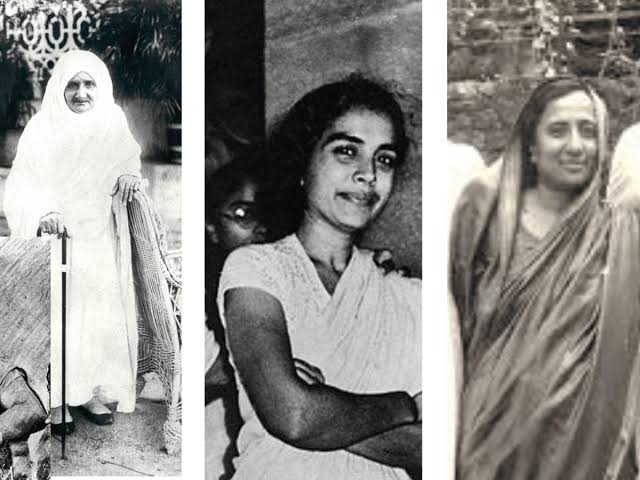
India’s Independence came with a promise. A new beginning. A free country. A future that belonged to its people. But August 1947 also carried another reality. Trains arrived filled with refugees. Families were separated. Homes were abandoned. Women and children disappeared. Neighbours who had lived together for generations suddenly found themselves on opposite sides of a border. In the middle of this violence, there were people who refused to choose hatred.
Bibi Amtus Salam was one of them.
Today, her name is barely remembered outside a few historical archives and Gandhian circles. But there was a time when Mahatma Gandhi trusted her enough to leave her behind in one of the most troubled regions of Bengal and tell her that she was the “moving spirit” behind whatever peace had been achieved in Noakhali. That is the story we need to remember.
A girl behind the purdah who decided to step outside. Bibi Amtus Salam was born into a conservative Muslim family of Patiala, in what is now Punjab. Archival records generally place her birth around 1906, while some later accounts give 1907.She belonged to a privileged family, but privilege did not necessarily mean freedom.Because of the family’s observance of purdah, she was denied formal schooling.For a young girl, the world was supposed to remain largely inside the boundaries of the home.But Amtus Salam did not accept that boundary forever.Around 1925, she discarded purdah and began moving into a much larger public world.It was a significant decision.She was not simply changing her clothes.
She was changing the life that had been prescribed for her.
Her search eventually brought her towards Mahatma Gandhi and his ashram. By the early 1930s, she had become a close associate of Gandhi, lived in his ashram and was treated by him as a daughter. The Prime Ministers Museum & Library records that she stayed with Gandhi from 1931 and that she learned spinning and weaving in the ashram.
Gandhi’s affection for her was not merely symbolic. In a 1934 letter to Sardar Patel, he described the apparently frail Salam as having a
“heart” of gold and a body of brass
—a striking description of someone whose physical appearance concealed an extraordinary determinatio
She chose Hindu-Muslim unity as her life’s work
For Amtus Salam, nationalism was never only about removing British rule. It was also about asking a much harder question: What kind of India would remain after the British left? Her answer was an India in which Hindus and Muslims could live together. She made Hindu-Muslim unity the central field of her work. The Prime Ministers Museum & Library describes her as a close Gandhian associate who began propagating khadi in 1922 and later chose Hindu-Muslim unity as her particular area of work. She travelled, worked in communities and became involved in Gandhian constructive programmes. She was not interested in being a famous face. Her politics was lived through service. And then came Noakhali.
When Noakhali was burning
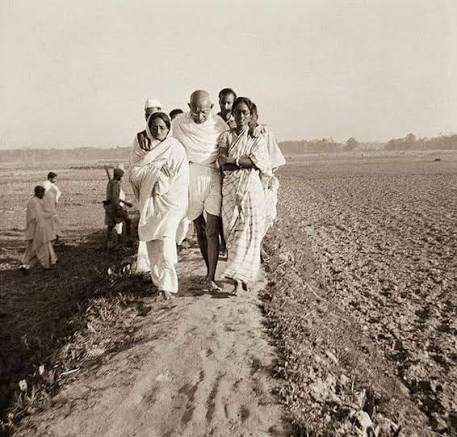
In late 1946, communal violence spread through Noakhali in Bengal. Gandhi went there because he believed that peace could not be restored from a distance. He walked from village to village. BHe met people. He listened. He entered places where fear had replaced trust. And among the people who accompanied him was a Muslim woman from Patiala:Amtus Salam.
Gandhi’s group was divided among different villages. Amtus Salam was stationed in Sirandi, where she worked to rebuild confidence and restore communal harmony. Gandhi’s own writings record her as a Muslim inmate of his ashram who had become his adopted daughter. But peace was not going to come easily.At one point, after an incident involving the removal of a sword associated with a Hindu temple, tensions remained high.
Amtus Salam decided that words were no longer enough.
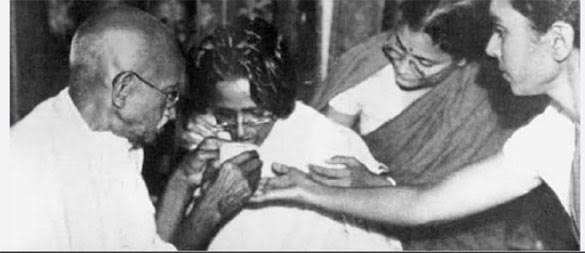
She began a fast.
She continued for 25 days in Sirandi, refusing to eat until those responsible accepted their wrongdoing and peace was restored. Archival accounts describe the fast as a significant part of the effort to rebuild communal trust in the area. Think about what that meant. Twenty-five days. Not behind a desk. Not from a political office. But in a village where trust had already collapsed. Her body became her protest. Her hunger became her argument. She was saying, in the simplest possible way:
If one community’s pain does not matter to the other, then peace is meaningless. Eventually, the people of the village agreed to a pledge of peace, and Gandhi helped bring her fast to an end. For Gandhi, her work in Noakhali was extraordinary.
In a letter to her, he wrote that she was the “moving spirit” behind whatever peace had been achieved in Noakhali, and described the work as her most significant contribution. Imagine receiving those words from Gandhi. Yet history somehow managed to make her almost invisible.
And then came Partition- For many people, Partition meant choosing a side.For Amtus Salam, it meant refusing to abandon people simply because their religion had changed the meaning of the border.Her own family was divided by Partition.Her brothers and much of her extended family moved towards Pakistan.She chose to remain in India.
And instead of retreating into the safety of her own community, she went towards the people who needed help. During 1947–48, she worked with Lajjawati Hooja, under the broader leadership of Rameshwari Nehru, in efforts to locate and bring back women who had been abducted or separated during the violence of Partition. Accounts of their work describe them assisting women on both sides of the new border.
Amtus Salam herself travelled to Pakistan in connection with this humanitarian work. Think about the courage that required. The border had just been created. Communities were suspicious of one another. People had lost homes, families and everything familiar. And yet she crossed that border—not as an enemy, but as someone trying to bring people home.
She stayed where the refugees needed her. After the immediate violence, another enormous crisis remained: Where would the displaced people go? The refugees who arrived in India needed homes. They needed work. Women needed safety. Children needed education. Families needed somewhere to begin again.
Amtus Salam settled in Rajpura and established the Kasturba Seva Mandir, which worked particularly with women refugees and destitute women. The Nehru Archive records that the institution was established to help resettle women refugees and that Salam remained closely involved in its work. She also worked with institutions involved in education and rural reconstruction. This was the less visible side of nation-building. No speeches. No dramatic photographs. Just the slow, exhausting work of helping people rebuild ordinary lives. A woman needed a place to stay. A child needed a classroom. A refugee family needed a livelihood. Someone needed to listen.Amtus Salam stayed.
She spent her life after Independence serving the people
This is perhaps what makes her story different.Many freedom fighters are remembered because their struggle ended with Independence.Amtus Salam’s work did not end on 15 August 1947.For her, Independence was not the finish line.It was the beginning of another responsibility.
She continued her work in refugee rehabilitation, women’s welfare, rural development and communal harmony. The Nehru Archive records her involvement with Kasturba Seva Mandir and related institutions at Rajpura for decades after Independence. She also remained connected with wider Gandhian and public-service institutions. By the 1980s, she was a permanent invitee associated with the All India Committee on Jail Reforms. She died on 29 September 1985. There was no grand ending. No final political speech. No national ceremony that permanently placed her name in the public imagination.She simply spent her life doing the work she had chosen.And then she was gone.
Perhaps that is why we need to remember her. When we talk about Independence, we often imagine the struggle as a straight line:British rule → freedom → Independence.But history was much more complicated.There was another struggle happening alongside it:
How do you build a country when the people of that country have been taught to fear one another?
Bibi Amtus Salam spent her life answering that question. She was born into a conservative household. She was denied formal education. She stepped beyond purdah. She joined Gandhi. She worked for Hindu-Muslim unity. She entered the troubled villages of Noakhali. She fasted for peace. She stayed in India when her own family moved towards Pakistan.
The Muslim woman who chose to stay
Perhaps the most powerful part of Bibi Amtus Salam’s story is not that Gandhi called her his daughter. It is not even that she fasted for 25 days. It is the choice she made when India was being divided.
That is why Bibi Amtus Salam deserves a place in the story of India’s Independence. Not merely as “Gandhi’s adopted daughter.” Not merely as a Gandhian. Not merely as a social worker. And certainly not as a forgotten footnote.
She was Bibi Amtus Salam — a Muslim woman who entered India’s freedom struggle, stood in the middle of its darkest communal violence, and spent the rest of her life trying to heal what Partition had broken. She did not just fight for a free India. She worked for a humane India. And perhaps, in an age when we are again reminded how fragile peace can be, that is the part of her story we need most.
Her story. Our heritage. Her India was one where no one had to lose their humanity to belong.