
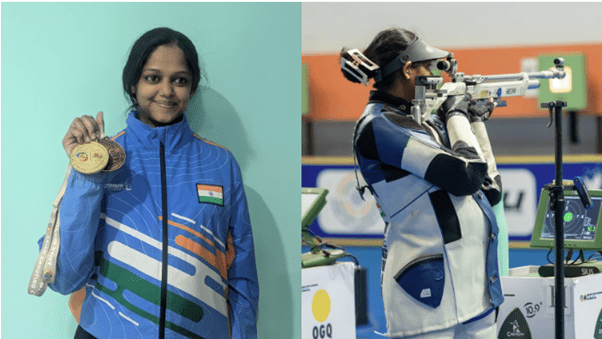
Meghana Sajjanar’s bronze medal at the Asian Shooting Championships 2026 in New Delhi is not just a sporting achievement; it is a powerful reminder of what determination, discipline, and belief can accomplish—even under the most demanding circumstances. The Bengaluru-based rifle shooter delivered this performance while being eight months pregnant, quietly redefining long-held assumptions about pregnancy, professional sport, and women’s physical capabilities.
Competing in the women’s 10m air rifle event at the Dr. Karni Singh Shooting Range, the 32-year-old shooter registered 628.6 in the qualification round and followed it up with 229.5 in the final, securing a place on the podium. At a stage where elite precision, balance, and mental control are non-negotiable, Meghana’s performance stood out not merely for the medal, but for the conditions under which it was achieved.
In her interaction with the media, Meghana acknowledged the intensity of the challenge. She described the competition as demanding both physically and technically, particularly during pregnancy, when even routine movements require adjustment. Rather than stepping away from the sport, she chose a carefully structured approach—reducing training load, prioritising technique, maintaining consistency, and working closely with medical professionals and coaches. This balance allowed her to stay competitive without compromising her health or that of her child.

 Eight Months Pregnant, Standing on the Podium
Shooting, unlike many other sports, demands prolonged stillness, controlled breathing, and precise posture. Pregnancy naturally alters posture, centre of gravity, and endurance, making Meghana’s achievement even more significant. Her ability to adapt her technique and remain composed under pressure speaks volumes about her experience as an athlete and her mental resilience.
Beyond the medal tally, Meghana Sajjanar’s success carries wider social meaning. In a society where pregnancy is often seen as a limitation rather than a phase of strength, her presence on the firing line challenged stereotypes in the most understated yet effective way—through performance. She demonstrated that with informed choices, institutional support, and personal resolve, women do not have to step back from their aspirations.
Her achievement was widely acknowledged across the sporting community, with fellow athletes and public figures praising her courage and discipline. The recognition was not rooted in sympathy, but in respect—respect for an athlete who competed on equal terms and delivered results.
Meghana’s bronze medal also contributed to India’s strong showing at the championships, reinforcing the country’s growing depth in shooting sports. Yet, its lasting impact lies beyond statistics. It lies in the message it sends to young women athletes, to expectant mothers, and to institutions that shape sporting environments: inclusion and support enable excellence.
At a time when conversations around women’s health, workplace flexibility, and equal opportunity are gaining momentum, Meghana Sajjanar’s journey offers a real-life example of what is possible when determination meets support. Her story is not about defying nature, but about understanding one’s body, respecting its limits, and still choosing to move forward.
This medal will be remembered not only as a personal milestone in Meghana Sajjanar’s career, but as a quiet yet powerful statement—that motherhood and ambition can coexist, and that excellence does not pause for life’s transitions.