For 74 years, the Shaurya Chakra remained an honour no woman had received.
Then in 2026, two naval officers quietly changed that history.
Lieutenant Commander Dilna K and Lieutenant Commander Roopa became the first women to be awarded the Shaurya Chakra, one of India’s highest peacetime gallantry honours. Their achievement was not written on a battlefield—but across oceans, storms, uncertainty, and months of relentless endurance.
To understand the significance of this moment, one must understand what the Shaurya Chakra represents.
Instituted in 1952 (earlier known as Ashoka Chakra Class III and renamed in 1967), the Shaurya Chakra is India’s third-highest peacetime gallantry award, given for acts of courage, exceptional bravery, and self-sacrifice away from direct combat. It has historically honoured military personnel and civilians who displayed extraordinary valour under difficult circumstances.
For decades, hundreds received this honour. Yet not a single woman stood among its recipients.
Dilna and Roopa did not come from professional sailing backgrounds. Their journey was built not on inherited expertise but on training, discipline, and the willingness to attempt something few imagined possible.
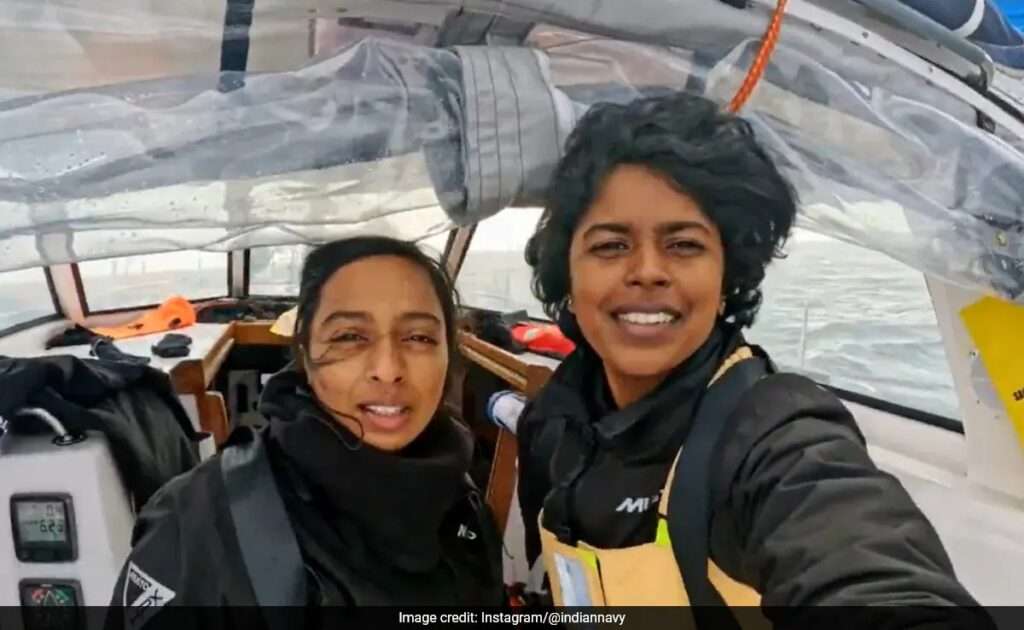
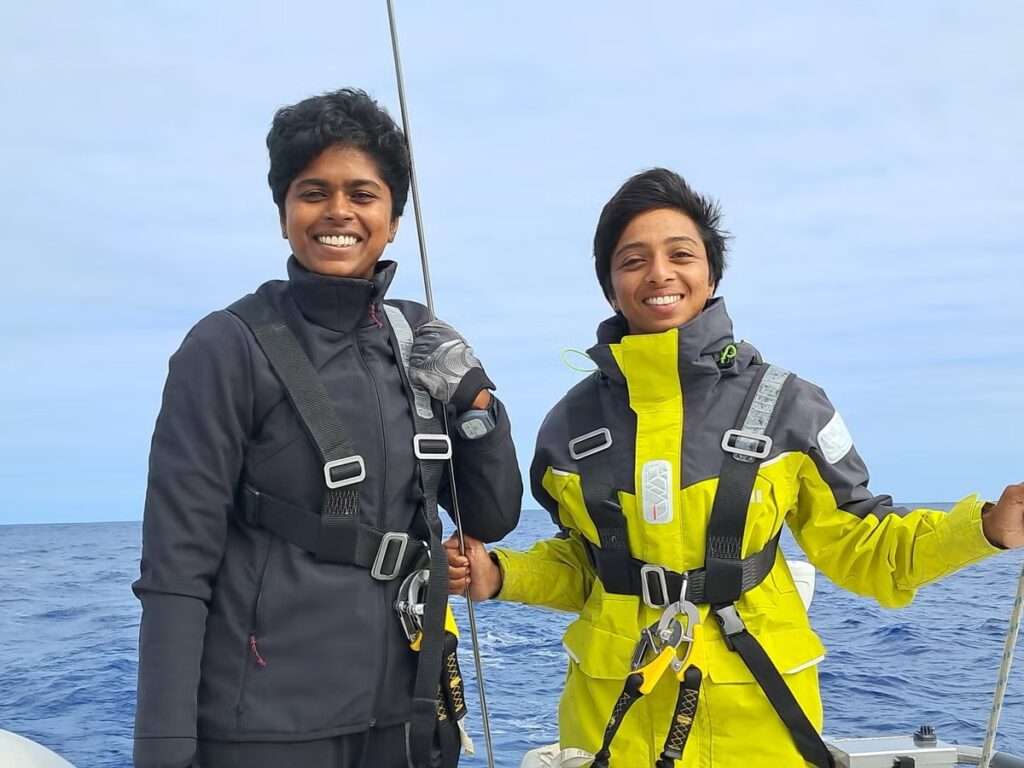
As part of the Indian Navy’s Navika Sagar Parikrama II, they set sail on an extraordinary mission—to circumnavigate the globe in double-handed mode aboard INSV Tarini. That meant two officers, one vessel, and thousands of kilometres of open sea with no external assistance, relying largely on wind power and navigation skills.
For nearly eight months, they crossed oceans, faced unpredictable weather, isolation, exhaustion, and the mental challenge of surviving far from land. Their voyage covered over 21,600 nautical miles—around 40,000 kilometres—before returning successfully to Indian shores. They became the first Indians to complete such a global circumnavigation in this format.
But perhaps the most powerful part of their story is not distance. It is possibility.
Because history often remembers women only when they become “the first.” Yet every first woman stands on years of invisible preparation, discipline, and moments when she chooses courage over comfort.
Dilna and Roopa’s achievement expands the meaning of bravery. It tells us that courage is not always dramatic. Sometimes courage is choosing to continue when the sea is endless, when there is no applause, and when turning back seems easier.
For young girls looking at uniforms and believing certain spaces still belong to others—their story says otherwise.
Leadership has no gender. Endurance has no gender. Courage has no gender. At Awaz-e-Khwateen, we celebrate stories like these because they remind us that representation is not symbolic—it changes imagination. And imagination changes futures.
For 74 years, no woman held this honour.
Now history will never say that again.