Introduction and Objectives of the Seminar
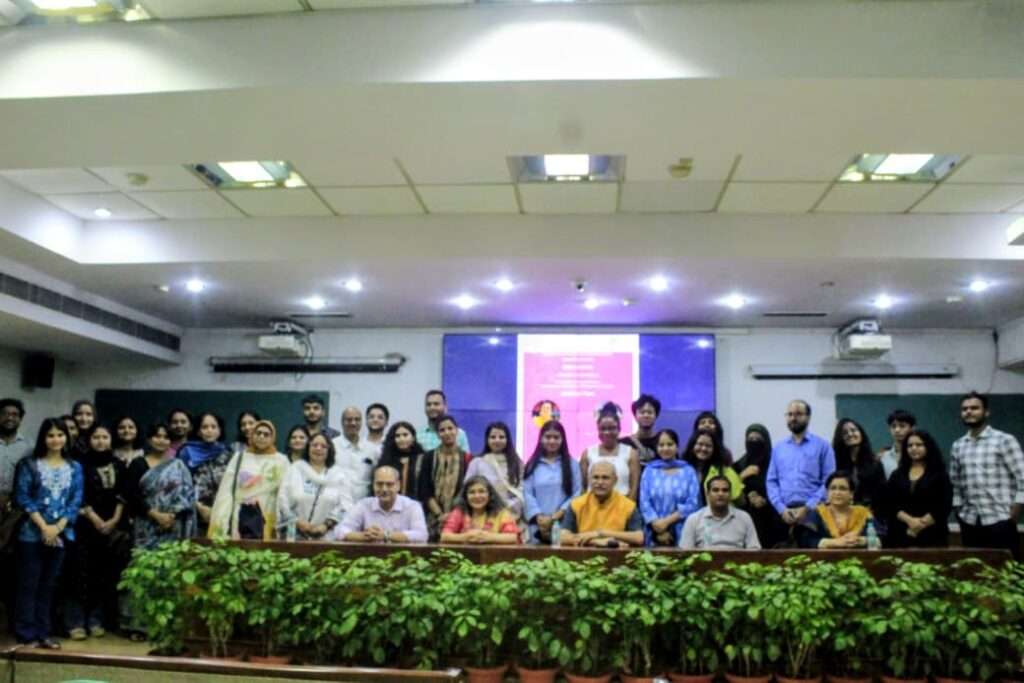
Sarojini Naidu Centre for Women’s Studies (SNCWS), Jamia Millia Islamia, in collaboration with the Sahitya Akademi, organized a one-day seminar on “Gendered Epistemologies: Unpacking the Indian Knowledge System” on 24 September 2026 at the FTK Auditorium, Centenary Gate No. 13, Jamia.
The programme was conducted under the leadership of Prof. Vijayalakshmi Barara, Director, SNCWS, and coordinated by Dr. Aparna Dixit. More than 140 participants, including scholars, researchers, students, and experts from outside the university, took part in the seminar. The main objective of the seminar was to view knowledge not as a neutral or static category, but as a dynamic process shaped by social relations, historical experiences, institutions, language, and power.
Inaugural Session
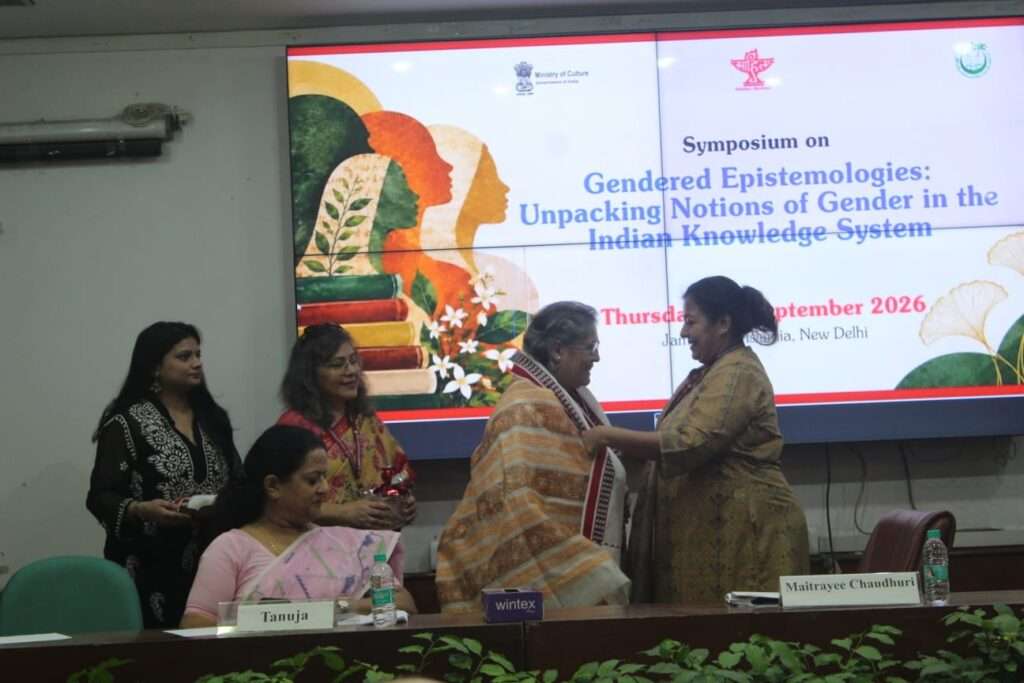
The inaugural session began with the welcome address by Ms. Mrig Nayani Gupta, Programme Officer, Sahitya Akademi, who highlighted the importance of documenting the undocumented. The Chief Guest, Prof. Tanuja, Dean (Academic Affairs) and Director, Centre for Social Inclusion Studies, Jamia, reflected on the concepts of ‘Gyan’, ‘Pran’, and ‘Vidwatta’, and emphasized the need to move beyond binary frameworks such as male-female and modern-ancient in order to understand the Indian Knowledge System.
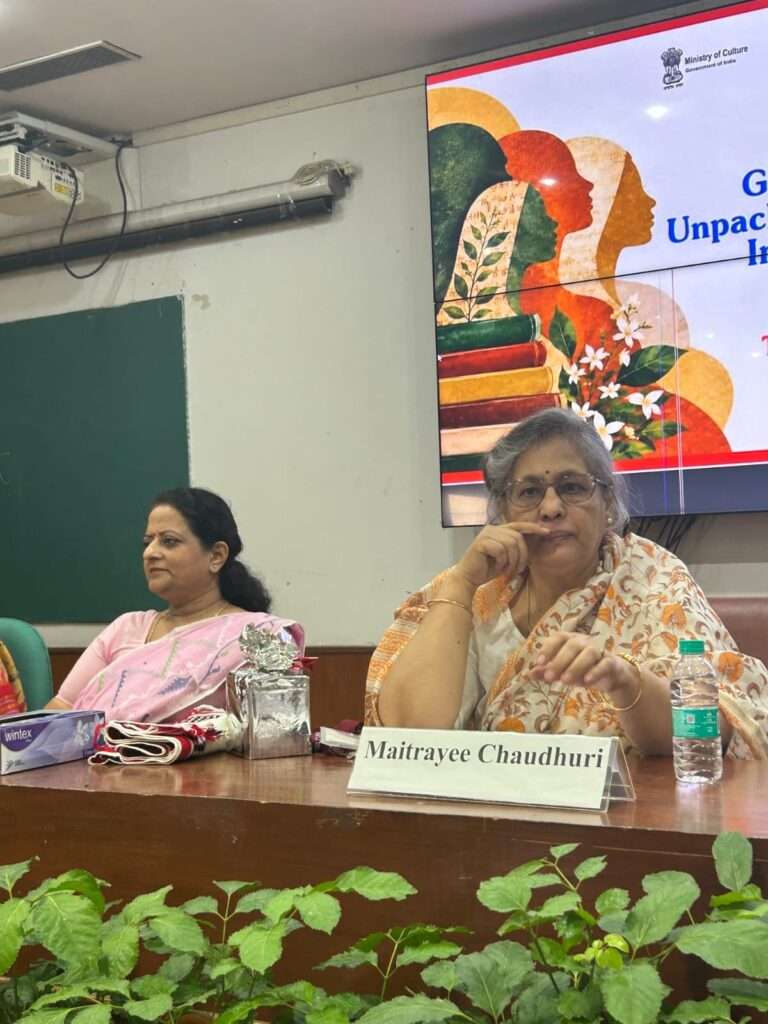
As the keynote speaker, renowned sociologist Prof. Maitreyi Chaudhuri underlined the importance of understanding the construction of knowledge and the process through which it is constructed, describing this as a central point of any dialogue with the Indian Knowledge System. Chairing the session, Prof. Vijayalakshmi Barara highlighted the significance of such academic events within the framework of the National Education Policy (NEP), 2020, and described it as a timely intervention in the field of gender studies and knowledge production.
First Session: Lived Experiences and the Indian Knowledge System
The first working session was organized under the title “Lived Experiences” and was chaired by Prof. Arvinder A. Ansari, Senior Professor, Department of Sociology, Jamia. In this session, Prof. Rekha Shangpliang (North-Eastern Hill University) and Prof. Gomti Bodra Hembram (Department of Sociology, Jamia) presented research papers on the lived experiences of the Khasi and Baiga communities, respectively.
The discussions raised issues such as gender, tribal communities, women’s rights, ecology, family, and community-based experiences, establishing that lived experiences are not merely illustrative, but an important source of knowledge and theory.
Second Session: Conceptual Interpretation and the Indian Knowledge System
The second working session was held under the title “Understanding the Indian Knowledge System” and was chaired by Prof. Preeti Sharma, Head, Department of History, Jamia.
In this session, Prof. Sudha Singh (Department of Hindi, University of Delhi) spoke about the invisibility of women in literature and the experiential nature of women’s knowledge and language. Prof. Rajnish Kumar Mishra (Centre for Sanskrit and Indic Studies, JNU), referring to ancient Sanskrit texts, urged that they be adopted as foundational references for understanding the Indian Knowledge System. Dr. Anjali Kapila (Retired, Lady Irwin College) presented a research paper on women’s folk songs in the context of the lives and challenges of women in Garhwal. The session expanded the dialogue through diverse perspectives such as Sanskrit studies, Hindi literature, comparative poetics, oral traditions, translation, and feminist literary criticism.
Conclusion and Key Findings
In the concluding session, Prof. Jitendra Kumar Srivastava, Registrar, Indira Gandhi National Open University (IGNOU), delivered the keynote address, in which he emphasized the importance of reading the works of Indian women writers and poets in order to understand how women have created, expressed, and transmitted knowledge.
The session was chaired by Prof. Zuber Minaai, Dean, Faculty of Social Sciences, Jamia, who highlighted the importance of such academic events in promoting interdisciplinary engagement with the Indian Knowledge System.
A central conclusion that emerged from the seminar was that in any dialogue with the Indian Knowledge System, it is essential to remain conscious of its diversity and internal plurality. It should include not only classical and textual traditions, but also oral histories, songs, memories, regional practices, community knowledge, women’s writings, indigenous and tribal epistemologies, and knowledge produced through everyday labour and experience. A gender-sensitive approach invites us to examine the structures through which knowledge is given authenticity and transmitted, thereby enabling women and marginalized communities to be recognized not merely as subjects of research, but as knowledge producers, interpreters, archivists, writers, artists, and custodians of intellectual traditions.
The programme concluded with a detailed report and vote of thanks presented by the Coordinator, Dr. Aparna Dixit, followed by the National Anthem.