
At 24, Shabana sits in a small room in Rajasthan’s Tonk district, balancing her toddler on one knee while attending an online tailoring course on her smartphone. A few years ago, such a scene would have been unimaginable. Married at 18, Shabana had dropped out of school after Class 10 and spent most of her time managing household responsibilities. She rarely stepped outside her village and had never used the internet.
Married at 18 and a mother by 19, she had left school before she could complete her education. Her world revolved around household responsibilities and caring for her family. During the pandemic, her husband purchased a smartphone. Initially, she used it only to speak with relatives. Gradually, she began watching tailoring tutorials, learning about government schemes, and exploring opportunities beyond her village.
Today, she earns a modest income by stitching clothes for women in nearby communities. Yet, despite her newfound confidence, she still struggles with irregular work, limited mobility, and poor nutrition.
Shabana’s story captures the central paradox of India’s latest National Family Health Survey (NFHS-6). Women are more connected, more educated, and more financially included than ever before. Yet many continue to face health challenges, economic exclusion, and social barriers that prevent empowerment from becoming a lived reality.
The recently released NFHS-6 (2023-24), covering nearly 6.8 lakh households across the country, presents a picture of remarkable progress alongside worrying new vulnerabilities.
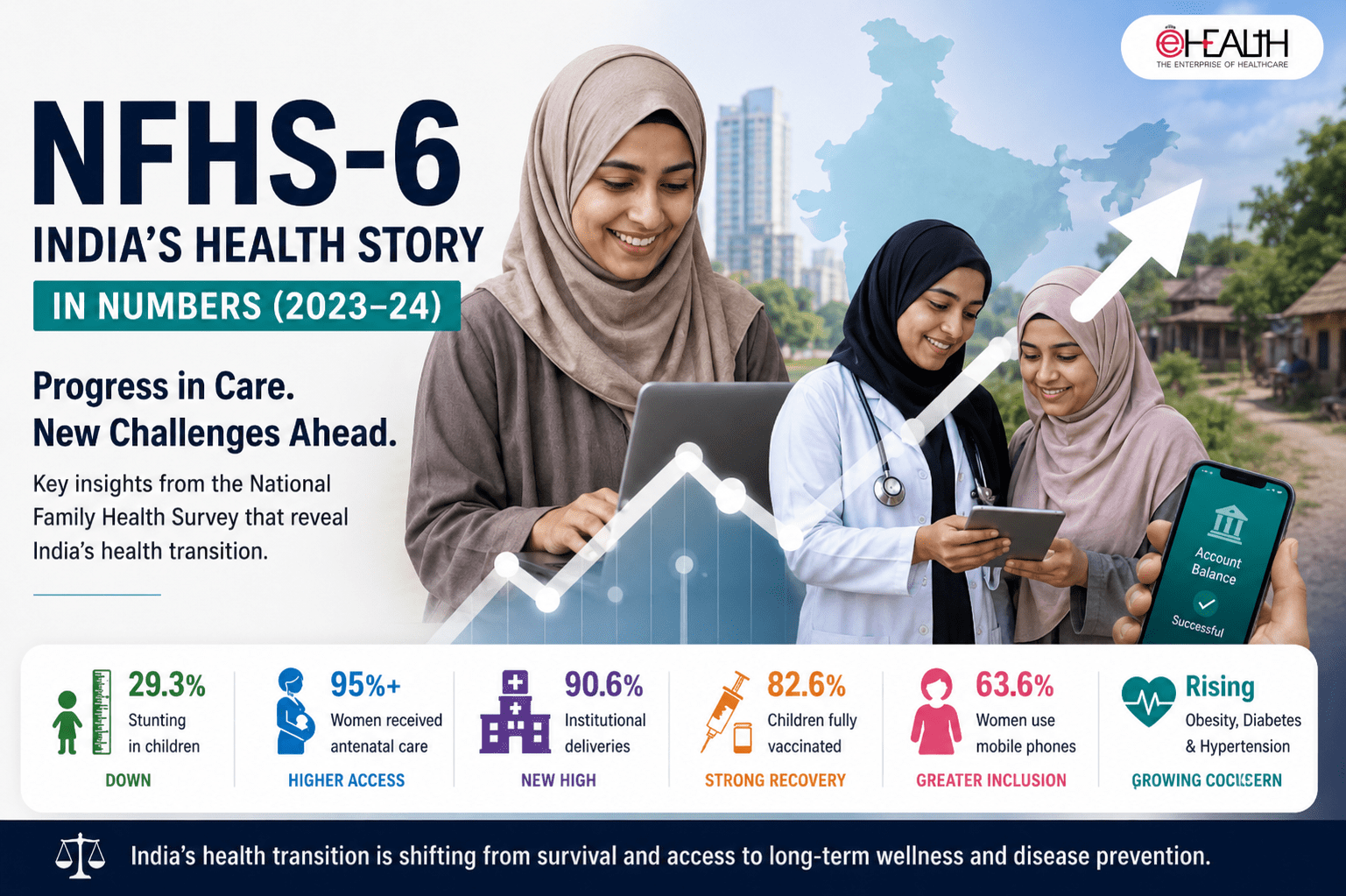
Perhaps the most celebrated finding is the digital transformation among women. The proportion of women who have ever used the internet has nearly doubled—from 33.3 percent in NFHS-5 to 64.3 percent in NFHS-6. Women owning and independently using mobile phones increased from 53.9 percent to 63.6 percent, while women operating their own bank accounts rose from 78.6 percent to an impressive 89 percent.
These figures represent more than technological access. They signify greater exposure to information, online learning, government services, financial independence, and participation in public life. For millions of women like Shabana, a smartphone has become a gateway to opportunities previously beyond reach.
Education has also improved steadily. The proportion of women with ten or more years of schooling increased from 41 percent to 46.4 percent. Child marriage has declined nationally, while reports indicate reductions in spousal violence as well. These are encouraging signs of gradual social change.
Yet celebrating these achievements without examining the accompanying challenges would present an incomplete picture.
One of the most concerning trends emerging from NFHS-6 is the rise of lifestyle-related diseases among women. Around 30.7 percent of women aged 15–49 are now overweight or obese, compared to 24 percent in the previous survey. The increase is particularly visible in urban India, where changing diets, reduced physical activity, and sedentary lifestyles are contributing to a growing public health crisis.
This raises uncomfortable but necessary questions. Has digital inclusion also contributed to reduced physical activity? Are smartphones and screens, while empowering women educationally and economically, simultaneously encouraging more sedentary lifestyles? While technology itself is not the cause, the rapid transition toward screen-centred living is reshaping health outcomes in ways policymakers cannot afford to ignore.
India is increasingly confronting what experts call the “double burden of malnutrition.” On one hand, undernutrition continues to affect millions of women and children. On the other, obesity, diabetes, hypertension, and high blood sugar levels are rising rapidly. NFHS-6 highlights growing concerns around non-communicable diseases and lifestyle-related risks, signalling a major shift in the country’s health profile.
Perhaps the most troubling aspect of the latest survey is not what it tells us, but what it does not. For the first time in recent NFHS history, anaemia data has been excluded from the released fact sheets due to concerns regarding testing methodologies. This omission has generated significant debate among public health experts because anaemia remains one of India’s most persistent challenges affecting women and children. NFHS-5 had reported that 57 percent of women aged 15-49 were anaemic. Without updated data, it becomes difficult to assess whether years of interventions have translated into meaningful progress.
The absence of this data is particularly concerning because anaemia is not merely a health statistic. It affects maternal health, productivity, cognitive development, and overall quality of life. A woman may possess a bank account, own a smartphone, and have completed secondary education, yet still suffer from chronic nutritional deficiencies. Such contradictions lie at the heart of India’s development story.
Economic empowerment presents another challenge. Although women are becoming more educated, access to quality employment remains limited. Millions continue to perform unpaid care work, balancing household responsibilities with informal economic activities that often go unrecognised and uncompensated. Educational gains have outpaced labour market opportunities, creating a gap between aspiration and reality.
Moreover, while child marriage has declined, it has not disappeared. For many young girls, particularly in rural and economically vulnerable communities, early marriage continues to interrupt education and restrict future opportunities. Progress, therefore, remains uneven and deeply shaped by geography, class, and social norms.
NFHS-6 ultimately tells a story far more complex than a simple narrative of success or failure.
India’s women are undeniably more educated, more connected, and more financially included than any previous generation. These achievements deserve recognition. However, rising obesity, increasing lifestyle diseases, persistent nutritional challenges, limited economic participation, and the continued burden of unpaid care work reveal that access alone does not guarantee empowerment.
The survey’s findings should serve not as a report card of accomplishments, but as a roadmap for future action. Real empowerment will not be measured by the number of smartphones women own or bank accounts they operate. It will be measured by whether women are healthier, economically independent, free from violence, and able to make choices about their own lives.
For women like Shabana, the journey has begun. The question before policymakers is whether India’s next phase of development can transform opportunity into genuine equality.Because when women move forward, a nation progresses. But when women’s health, dignity, and agency remain compromised, no amount of statistical progress can truly be called development.
At 24, Shabana sits in a small room in Rajasthan’s Tonk district, balancing her toddler on one knee while attending an online tailoring course on her smartphone. A few years ago, such a scene would have been unimaginable. Married at 18, Shabana had dropped out of school after Class 10 and spent most of her time managing household responsibilities. She rarely stepped outside her village and had never used the internet.