Submitted By Madiha- Student At Jamia Millia Islamia ( M. A in History)
INTRODUCTION:THE WOMEN BEHIND THE STEREOTYPE
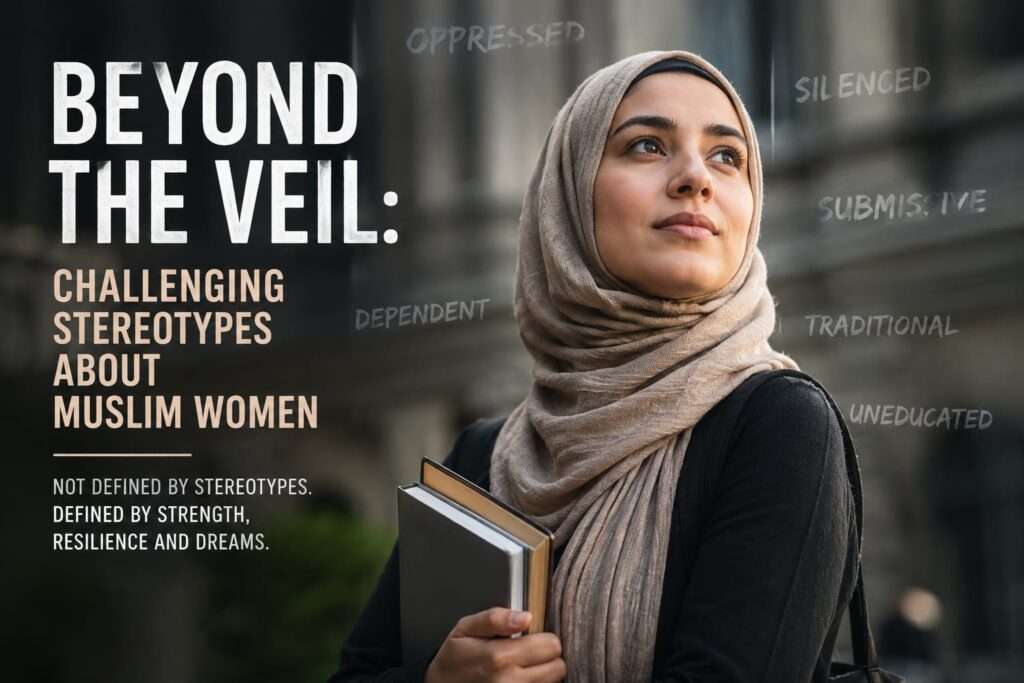
In public discussions concerning religion, culture, gender, and freedom Muslim women are frequently at the center. Yet paradoxically, though, they are not usually given the chance to express themselves. Stereotype that depict people as downtrodden, obedient and illiterate or lacking independence are often used to explain their lives. This depictions may be just as restrictive as the bigotry they support to oppose. The truth is for more naunced. Muslim women are not all the same. Their cultural traditions, economic origins, educational attainment, and countries of origin are on diverse. They seek district goals, have different ideas, and make different decisions. While some people decide to wear the hijab, while others do not. While some are stay at home moms, other works as educators, physicians attorneys, business owners, researchers, artists, social workers and legislator.To truly understand the Muslim women, it is very important to go beyond the generalization and pay attention to their different and unique experiences.
THE VIEL DOES NOT DEFINE THE WOMEN
One of the most prominent storage type associated with Muslim women is that belief that the hijab or veil inherently signifies oppression.However, clothing alone cannot provide a complete understanding of individuals freedoms or identity for many Muslim women, donning the hijab serve as a manifestation of their faith, identity modesty or personal choice conversely, for others, their clothing choices may be shipped by family, culture norms, societal expectations, or a personal situation. The crucial inquiry should not merely be,” is she wearing a veil”? Rather, we ought to consider whether she possesses the autonomy to make significant choices regarding her own life. Are women’s empowerment or disempowerment is not slowly determined by her attire factors such as her education, access to opportunities, decision making capabilities, economic independence, safety, and societal participation serve As for more substantial indicators of empowerment.
THE MUSLIM WOMEN ARE NOT A HOMOGENEOUS COMMUNITY WITH A UNIFORM NARRATIVE
One of the most significant error in conversation regarding Muslim women is the assumption that they all possess identical experiences. A university is a university student in Delhi may encounter entirely different opportunities and challenges compared to a women who lives in a rural village. similarly a working professional may perceive society in a manner distinct form of from that of a homemaker. a woman of affluence may have access to resources that are not available to a women and from the low income background. Even among members of the same family or community, the experiences of women can vary greatly. Elements such as class, education, geographical location, economic status, family dynamics, and access to technology can all impact women ‘s opportunities. Does, there is no single singular definition of a Muslim women. There exist millions of Muslim women, and as a result, millions of unique.
THE MISCONCEPTION REGARDING THE AMBITION OF MUSLIM WOMEN
A prevalent stereotype suggests. That Muslim women Possess Less ambition Or show diminished interest in education and career pursuits. Disbelief fails to recognise the numerous Muslim women who are diligently engaged in education, professional careers, entrepreneurship, research, public service and social work.
From educational institutions to healthcare facilities, universities to cooperate environments, and quotes to community organizations, Muslim women make significant contribution to society in various capacities. Additionally, many women contribute within their families and communities in ways that often go unnoticed or are undervalued. This issue is not inherently a lack of ambition. In many in many instances women encounters challenges that hinder their ability to transform their ambitions into tangible opportunities.
This distinction is crucial. Rather than questioning why women “do not succeed”, we ought to inquire whether they have equal access to education, employment, financial resource, mentorship, safe working environments, and space for decision making.
WHEN SOCIAL ISSUES ARE CONFUSED WITH RELIGIOUS ISSUES
It is essential to address the challenges encountered by the Muslim women. However, we must exercise caution in not attributing every hardship faced by a Muslim woman slowly to Islam.Factors such as domestic violence, poverty, limited access to education, early marriages, economic dependency, discrimination and restriction, on mobility can impact women across various communities. The origin of this issue can be intricate and may encompass social customs, economic circumstances, tractical mindsets, insufficient institutions, and a lack of awareness.
Reducing all these challenges to a matter of religion simplifies the experience of women and hinders our understanding of their true causes. On the same time, recognizing the influence of culture or social structures should not equate to this regarding real issues with specific communities. A nonstop that we acknowledge problems candidly while steering clear of broad generalization.
THE MEDIA AND THE “ OPPRESSED MUSLIM WOMEN” NARRATIVE
Media representation significantly shapes societal perception of communities that individuals may not have personal experience with. Muslim women’s are often depicted through two contrasting narratives one narrative says that primarily as victim in needs of rescues, while the other showcases a successful Muslim women as an exceptional case. Both of these narratives can be problematic.
The first narrative undermines women agency by depicting them slowly as victims. The second implies that ordinary accomplishments are remarkable merely because the individual is Muslim.
Muslim women should be represented in narratives as whole human beings not just a symbol of operations, resistance, religion, or empowerment.They can embody a range of identities ambitious and uncertain, successful and struggling, traditional and modern, religious and professionally engaged, These identities can coexist without contradiction.
EDUCATION A POWERFUL TOOL FOR EMPOWERMENT
Education stands as one of the most crucial means of broadening women’s choices.It does more than just open doors to employment it enhances awareness of legal rights, financial literacy, health, technology, and civic engagement. For Muslim women, access to quality education can simultaneously address multiple barriers educated uneducated girl may develop increased confidence in decision making, seizing opportunities, and articulating her needs. However, education should not be limited to merely placing girls in classroom. The quality of education, safety, affordability, digital access, family support, and post education opportunities are all important considerations. The objective should be to foster an environment where women are not only educated but also empowered to utilize their education to influence their futures.
ECONOMIC INDEPENDENCE AND POWER OF CHOICE
Financial independence represents a crucial aspect of women’s empowerment. When women are provided with opportunities to earn, manage their finance, enhance their skills, or started their own business, they gained increased control over the decisions that impact their lives.This does not imply that every women must hold a formal job to be deemed empowered. The roles of home making and caregiving are equally important forms of work. Instead economic empowerment entails ensuring that women have access to resources and are not denied opportunities slowly based on their gender. Consequently skill development, vocational training, entrepreneurship programs digital literacy, and access to financial resources can significantly contribute to bolstering women ‘s independence.
KNOWING RIGHTS IS AS IMPORTANT AS HAVING RIGHTS
Legal right holds little practice significance if women are unaware of their existence or unable to access the mechanism that safeguard them. Legal and social awareness can empower women to comprehend issues related to education, employment, marriage, inheritance, domestic violence, financial rights, and access to public services. Organization that work with Muslim women can play a vital role in this regard by establishing safe environments where women can inquire without fear of judgment. Awareness should extend beyond merely informing women of what they cannot do it should also educate them on their entitlements, where to seek assistance, and how to engage in decisions that influence their lives.
LISTENING INSTEAD OF SPEAKING FOR WOMEN
One of the most crucial transformation we require is a shift in how we engage in discussions regarding Muslim women.Frequently, conversation commence with preconceived notion about the needs of Muslim women. However, true empowerment should initiate with active listening. A woman residing in a specific community poses a deeper understanding of a situation then an outsider observing that community. Therefore, tired to formulating programs or policies for women, organization should inquire about the actual needs of these Women. Do they require enhanced educational opportunities? Skill training? Financial assistance? Legal knowledge? Healthcare? Digital skills? Safe transportation? Job prospects?
The response may vary across different communities. Genuine environment commencement women are involved in the decision making process regarding their own lives, rather than merely being recipients of decision made on their behalf.
BEYOND THE BINARY OF “ OPPRESSED” AND “ EMPOWERED”
Another significant misconception is the belief that a woman is either oppressed or fully empowered.Reality does not conform to such simplistic classification. A woman may possess a high level of education yet remain economically reliant she may enjoy financial independence but encounter social discrimination she may have a thriving career while struggling to meet family expectations. She may make autonomous choices while still adhering to religious customs. Human experiences are intricate and women’s lives cannot always be categorised in straightforward terms. Acknowledging this complexity enables us to engage in more profound discussions about gender and empowerment.
CREATING A MORE INCLUSIVE FUTURE
Challenging stereotype does not imply ignoring the existence of discrimination or inequality full stop rather comma it involves confronting these issues without reducing an entire community to these challenges.The path forward necessitates investment in education, employment, healthcare, legal awareness, digital literacy, leadership opportunities, and safe environments for women to voice their thoughts.To confront stereotypes regarding Muslim women it is essential to transcend assumption and focus on the individual rather than the label. We must acknowledge both the difficulties women encounter and the autonomy with which they address those difficulties.
Muslim women should not be compelled to conform to societal expectations of what an oppressed woman or an empowered woman ought to resemble. They are entitled to the liberty to define their own identities.Beneath the veil exist not a singular narrative but a multitude of narratives the true challenge lies not invoicing opinion on behalf of Muslim women, but in fostering environments where they can express themselves.