Tooba khatoon | Updated by Yusra siddiqui | awazekhwateen
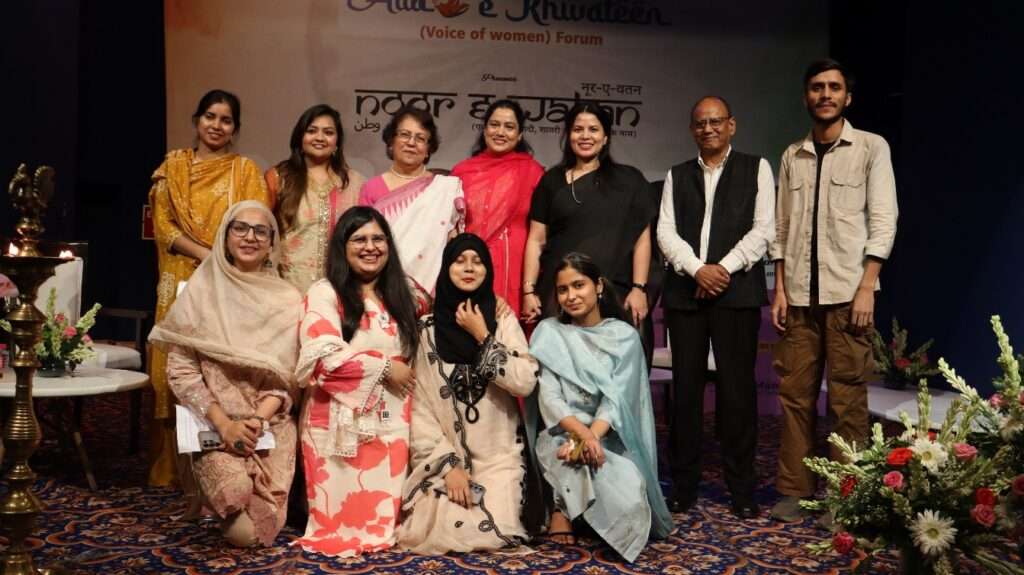
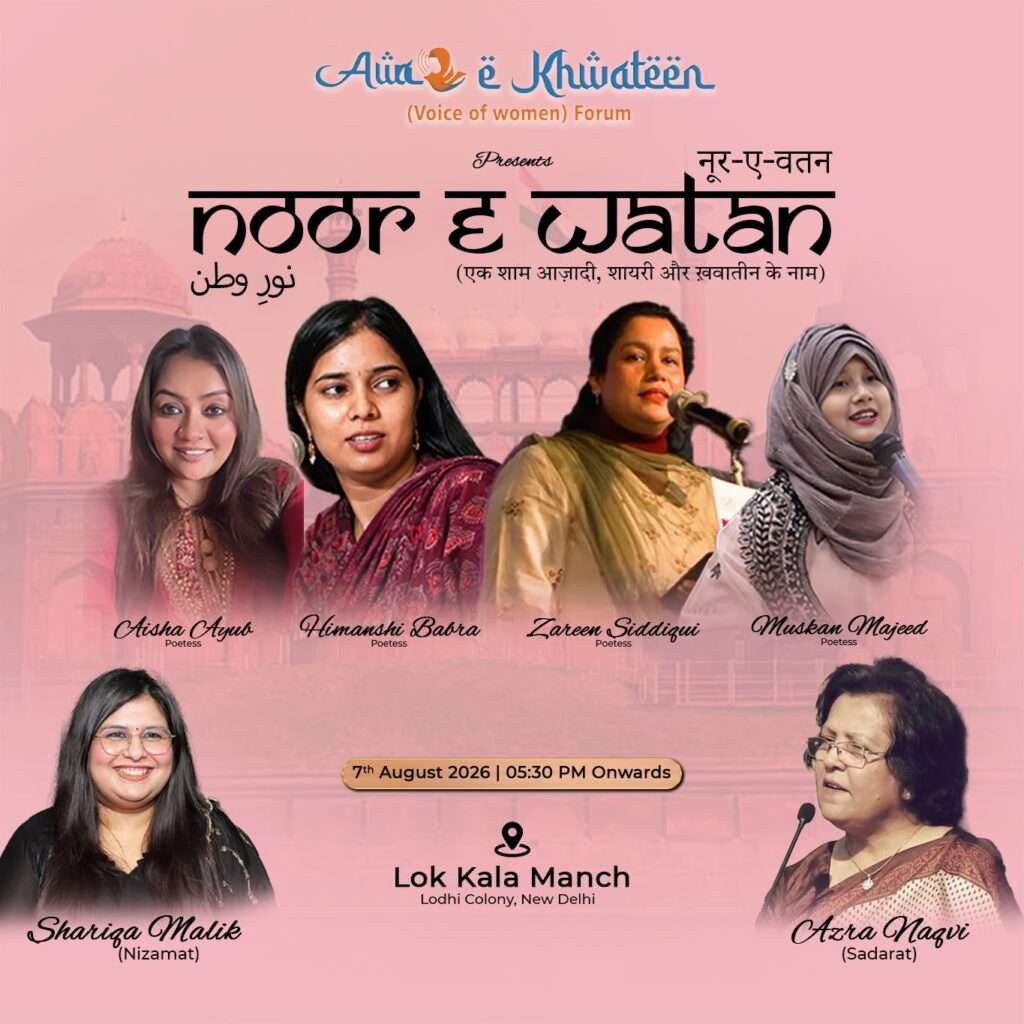
Some evenings are remembered not because of the scale of the event, but because of what they make people feel and think about afterwards. “Noor-e-Watan: Ek Shaam Azadi, Shayari aur Khwateen Ke Naam”, organised by Awaz-e-Khwateen, was one such evening. Held against the backdrop of Independence Day, the mushaira brought together women poets, literature lovers and an audience that stayed through the rain to listen to poetry that moved between love, loss, identity, work, womanhood and the meaning of freedom.
The idea behind the evening was simple: to create a literary space where women could take the stage and speak in their own voices. But the evening gradually became more than a women-centred mushaira. It became a conversation about what freedom looks like beyond the historical memory of 15 August.
Independence Day celebrations often rely on familiar images of the nation—flags, patriotic songs, historical memories and stories of sacrifice. Noor-e-Watan approached the occasion differently. It asked the audience to listen to freedom through the intimate language of poetry. The poems did not always speak directly about the nation. Some spoke about relationships, loneliness, exhaustion, expectations and silence. Yet these personal experiences were precisely what gave the evening its larger meaning.
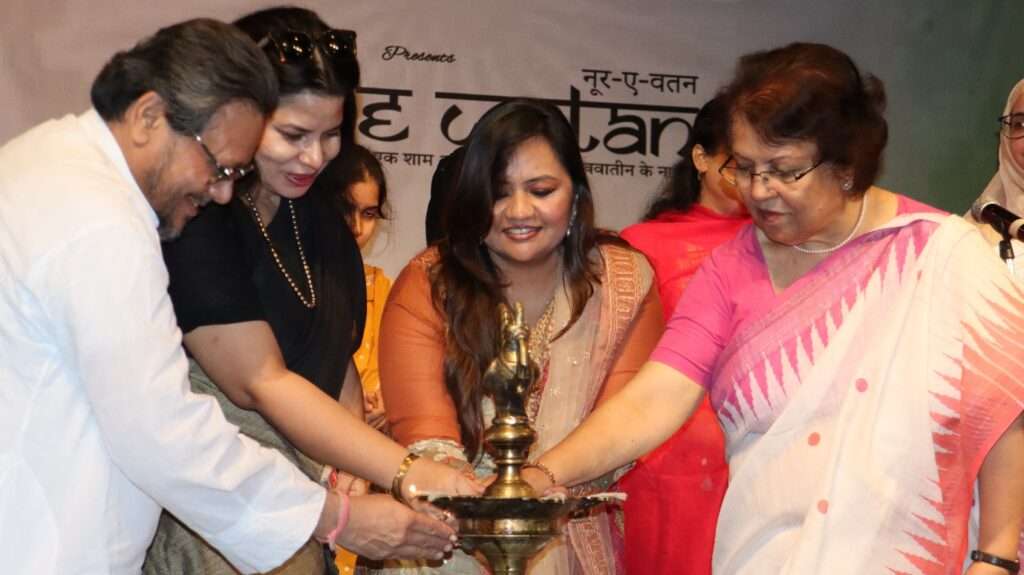
One of the striking features of the programme was the presence of women poets from different backgrounds and with different poetic sensibilities. Their work demonstrated that there is no single way of writing about womanhood. For some, it emerged through love and relationships; for others, through questions of identity, social expectations or the everyday realities of working women.
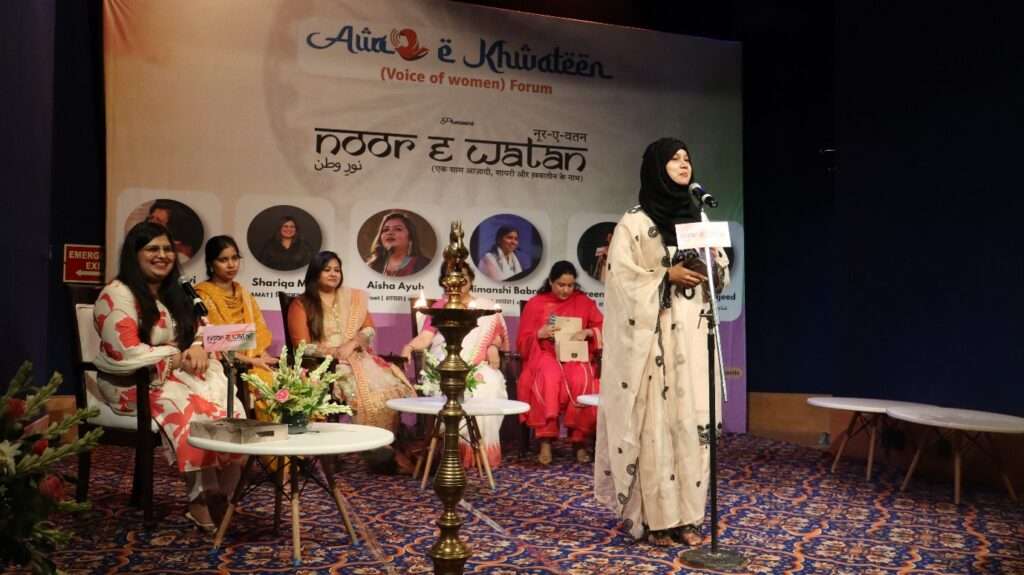
Muskaan Majeed’s poetry, for instance, brought the audience into the complicated space between personal feelings and family expectations. Her couplet,”
“Maa-baap ki raza thi so see liye lab,Kaise kahun ki mujhko yeh ladka nahi pasand.”
captures a familiar conflict the moment when personal choice becomes difficult to express in the face of familial expectations. Her poetry did not need to make a political argument directly; the tension was already present in the silence of the speaker.
The mood shifted with Zareen Siddiqui, whose poetry explored loneliness and emotional isolation. Her lines,
کاش محبت کا غم مجھ پر اپنی گرفت چھوڑ دے
میں تیرے پاس ہوں پھر بھی میری روح کا باغ اتنا تنہا کیوں ہے؟
“Gham-e-ulfat kabhi chhod de daaman mera,Tere pehlu mein hoon phir bhi hai kyun gulshan mera tanha.”
gave voice to the strange experience of feeling alone even in the presence of another. Her poetry also moved towards wider social concerns, touching upon poverty, hunger and changing human relationships.
“Faqat zanjeer khulne se koi azaad hota hai?
Abhi se khush nahi hona, abhi zanjeer kholi hai.”
But the question of freedom became most direct in the poetry of Himanshi Babra. Her words, challenge the easy assumption that freedom is a finished achievement. The metaphor of the chain becomes a way of asking whether political independence automatically translates into social, economic and personal freedom. Her contribution gave the evening a distinctly contemporary dimension: the freedom celebrated on Independence Day can also be examined through the freedoms people experience in their everyday lives.
This idea found another expression in Shariqa Malik’s poetry. Beginning with the nation and the memory of sacrifice, her verses gradually turned towards the everyday lives of women. Her lines,
“Har baat pe palkon ko bhigoya nahi karte,Rona bhi agar aaye to roya nahi karte.”
carry the emotional restraint that many women are expected to maintain. Her poetry also spoke about the exhaustion of working women those who move from professional responsibilities to household responsibilities without necessarily finding time for themselves.
That shift from the nation to the everyday was perhaps one of the most meaningful aspects of the evening. It suggested that patriotism need not always be expressed through grand declarations. It can also be found in recognising the lives of ordinary citizens and asking whether the freedom of the country is reflected equally in their everyday experiences.
Ayesha Ayub’s contribution further strengthened the theme of voice and self-expression. Her couplet,
“Khamoshiyon ki sadaaon mein ye asar kar de,Jo sar-nigoon hain, tu unke buland sar kar de.”
speaks of transforming silence into strength. The lines fit naturally into the larger purpose of the evening: providing a platform where women could move from being subjects of conversation to becoming its authors and speakers.
The evening also looked towards the changing landscape of women’s writing through Azra Naqvi, whose reflections on contemporary women poets highlighted the freshness and directness of a newer generation of writers. Her own words,
“Ae kalamkaar qabile ki saheli meri,Tujhse rishta hai purana mera.”
evoke a relationship between women writers across generations. The image is particularly significant because women’s literary histories have often been fragmented or overlooked. Writing, therefore, becomes not only an artistic act but also a means of remembering and connecting with those who wrote before.
Her poetry also returned to the larger theme of the nation. Rather than presenting patriotism only through slogans, it connected the idea of India with values such as peace, humanity, affection and coexistence. In that sense, the evening’s understanding of watan was broader than territory. It was about the kind of society people hope to leave for those who come after them.
A Rainy Evening to Remember
Perhaps what made the evening particularly memorable was the weather. Heavy rain could easily have emptied a venue, but the audience continued to arrive and remained present through the programme. Azra Naqvi herself remarked upon the unusual experience of performing before an audience that stayed despite the rain.
By the end of the evening, the formal programme had concluded, but the central idea remained: freedom is not only something we celebrate; it is something we continue to define. For the organisers, the purpose of creating a women-centred mushaira was not simply to provide another cultural programme. It was about creating encouragement and an environment in which women could take the microphone, share their work and occupy a public literary space with confidence.
And perhaps that is what made Noor-e-Watan more than an Independence Day mushaira. It brought together three things that are often discussed separately—freedom, literature and women’s voices.
There were poems about love and loneliness, family and work, the nation and its people. There were questions about what it means to truly be free. And there was, above all, the simple act of women standing on a stage and speaking in their own words.
Outside, it was raining.
Inside, the poetry continued.
And for one evening, Noor-e-Watan was not merely about celebrating the freedom we inherited, but about thinking about the freedom we still have to build.